




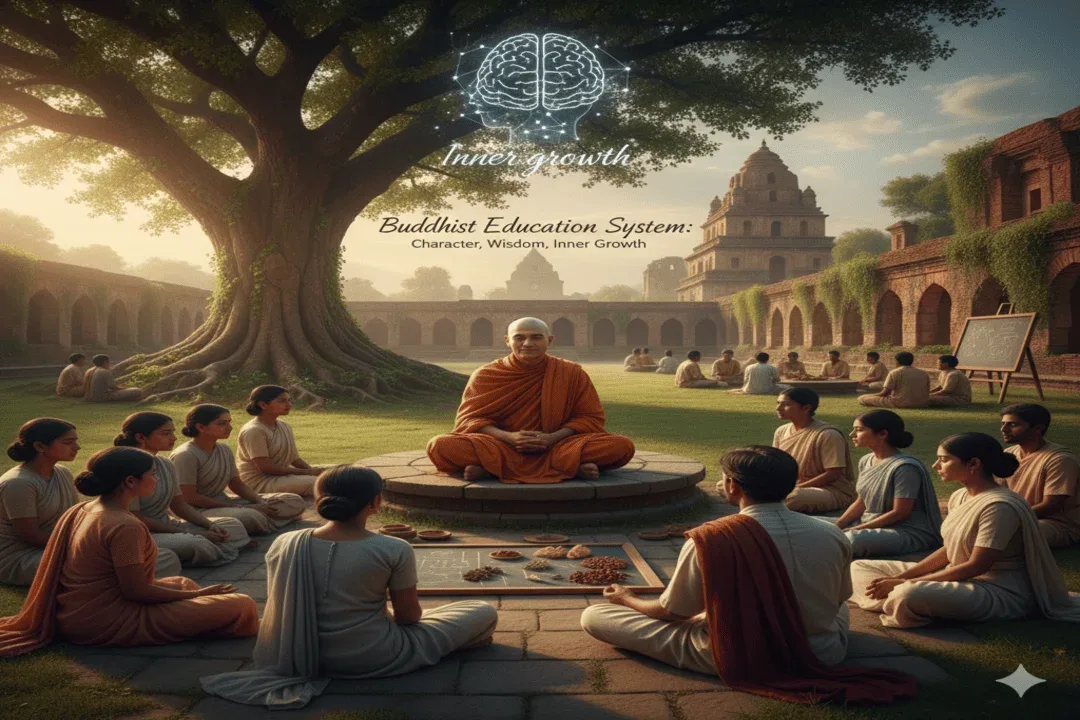
If you close your eyes and imagine “education,” chances are you’ll think of blackboards, classrooms and exams. But education hasn’t always looked like this. Thousands of years ago, India had a very different system of learning that shaped not just the country but also large parts of Asia.
One of the most remarkable traditions was the Buddhist education system. Born during the time of Gautama Buddha, it focused less on rote learning and more on character, wisdom and inner growth. While the Vedic system of education revolved around rituals and sacred texts, Buddhist education opened its doors to all rich or poor, high caste or low caste.
In this article, we’ll explore the Buddhist education system in ancient India, see how it evolved in modern India and reflect on why its principles are still relevant in today’s fast-paced world.
Buddhist Education System in Ancient India
Origins and Context
The Buddhist education system emerged around the 5th to 6th century BCE, when Gautama Buddha began teaching his philosophy of life, suffering and liberation. At the time, Indian education was dominated by the Vedic tradition, where access to learning was largely restricted to the upper castes.
Buddhism challenged this exclusivity. Buddha taught in Pali and Prakrit languages people actually spoke instead of Sanskrit, which was used mainly by scholars and priests. This simple shift made knowledge accessible to common people, breaking centuries old barriers.
Learning Centers: Viharas and Universities
The main places of learning were monasteries (Viharas). Over time, these monasteries developed into full-fledged universities, attracting students from across the world.
Some famous institutions were:
- Nalanda University (Bihar) – Considered one of the first residential universities in the world. At its peak, it had thousands of students from countries like China, Korea and Sri Lanka. Subjects ranged from philosophy and grammar to astronomy and medicine.
- Vikramashila University (Bihar) – Specialized in Buddhist philosophy and tantric studies.
- Takshashila (Taxila, now in Pakistan) – A hub of multidisciplinary education, from politics and warfare to medicine and art.
These institutions functioned like international universities today. Students traveled long distances, stayed in hostels and studied under expert teachers.
Subjects Taught
The curriculum of Buddhist education was broad and practical. Students were not just trained in religion but also in worldly knowledge. Some key subjects included:
- Philosophy – Buddhist, Jain and Vedic schools were studied and compared.
- Logic and Debate – Students sharpened reasoning and argumentation skills.
- Languages – Pali, Sanskrit and later Tibetan and Chinese.
- Medicine – Surgery, herbs and preventive care.
- Arts and Crafts – Sculpture, architecture, painting and music.
- Ethics and Meditation – To train both the mind and heart.
The goal was not only to produce scholars but also well-rounded individuals who could serve society.
Teaching Methods
The Buddhist education system encouraged active learning rather than rote memorization. Methods included:
- Dialogues and Discussions – Teachers (Acharyas) encouraged students to question and debate.
- Meditation Practices – To build focus, self-discipline and emotional control.
- Practical Training – Especially in fields like medicine and arts.
- Oral Transmission – Knowledge was passed down through chants and recitations before being written.
This holistic approach meant students weren’t just preparing for exams they were preparing for life.
Comparison with Vedic Education
| Aspect | Vedic Education | Buddhist Education |
| Language of Learning | Sanskrit (elitist, restricted) | Pali/Prakrit (common people’s language) |
| Access | Mostly upper castes (Brahmins, Kshatriyas) | Open to all, regardless of caste |
| Focus | Rituals, sacrifices, scriptures | Ethics, reasoning, practical knowledge |
| Learning Centers | Gurukuls, Ashrams | Monasteries, Universities (Nalanda etc.) |
This openness made the Buddhist system highly influential not just in India but across Asia.
Buddhist Education System in Modern India
Decline and Rediscovery
By the 12th century, many Buddhist institutions in India were destroyed during invasions, and Buddhism itself declined. But its influence remained alive in other countries like Tibet, Sri Lanka and China.
In India, Buddhism saw a revival in the 20th century, thanks to leaders like Dr. B.R. Ambedkar, who embraced Buddhism as a way to fight caste discrimination. This revival also brought renewed interest in the Buddhist education system.
Modern Institutions
Today, several universities and institutes keep the tradition alive:
- Nalanda University (Revived) – A modern international university in Bihar inspired by the original Nalanda.
- Central Institute of Higher Tibetan Studies (Sarnath, UP) – Specializes in Buddhist philosophy and Tibetan culture.
- Mahayana and Theravada Centers – Across Bodh Gaya, Sarnath, Ladakh and Maharashtra.
Apart from universities, many Buddhist monasteries also function as modern schools, teaching both secular subjects and Buddhist philosophy.
Buddhist Practices in Education Today
- Mindfulness and Meditation – Widely used in schools and workplaces to reduce stress.
- Value-Based Learning – Buddhist principles like compassion, non-violence and discipline are being reintroduced into curricula.
- Peace and Conflict Studies – Modern courses often draw from Buddhist ideas of non-violence and harmony.
Relevance in the 21st Century
In today’s world of competition, stress and social inequality, Buddhist education offers:
- A focus on mental health through meditation.
- Ethical grounding in a world often driven by material success.
- A reminder of the importance of equality and accessibility in education.
In short, Buddhist education may be ancient, but its values are timeless.
Philosophy and Key Teachings in Buddhist Education
At its core, Buddhist education was built on the teachings of Buddha:
- Four Noble Truths – Understanding suffering and how to overcome it.
- Eightfold Path – Right speech, right livelihood, right effort and so on principles that shaped students’ lives.
- Vinaya (Discipline) – A strict code of conduct for monks and students.
- Equality and Compassion – Everyone deserves knowledge, regardless of birth.
Unlike systems focused on creating priests or bureaucrats, Buddhist education aimed to create compassionate thinkers, teachers and healers.
Why the Buddhist Education System Still Matters
- It promoted universal access to education long before modern democracies.
- It laid the foundation for the concept of universities as global learning centers.
- Its focus on ethical living and mindfulness resonates strongly in today’s stressful world.
- It shows us that true education is not just about jobs it’s about becoming better human beings.
Conclusion
The Buddhist education system is one of the shining chapters in India’s educational history. In ancient India, it created universities like Nalanda and Takshashila that attracted students from across Asia. In modern India, it is being revived through universities, research centers and practices like mindfulness.
When we look at India’s long educational journey, the Buddhist system stands alongside other traditions like the Gurukul Education System, which focused on spiritual and practical training under a guru and later systems such as the Madrasa Education System and the British Education System in India, each of which shaped learning in different ways. Exploring the Takshashila University history also shows us how India was a global hub of knowledge long before modern universities.
Its message remains timeless: education should not just fill our minds with facts but also shape our hearts and character. As we search for ways to make education more meaningful today, perhaps the answers lie not only in new technologies but also in the wisdom of the past. The Buddhist education system, with its blend of knowledge, ethics and compassion, may very well be the model we need for a balanced future.
FAQs
Buddhist education is based on the teachings of Gautama Buddha. It focuses on values like morality, meditation, reasoning and practical knowledge. Instead of stuffing the mind with facts, it also teaches how to live wisely and peacefully.
Vedic education was often limited to certain castes and mostly revolved around rituals. Buddhist education, on the other hand, was open to everyone. It gave importance to equality, ethics, logic and useful life skills, something like the “open-source learning” of ancient India.
The most famous were Nalanda, Vikramashila and Takshashila. Think of them as the Harvards and Oxfords of ancient Asia, where thousands of students studied subjects ranging from philosophy to medicine.
Absolutely! Concepts like mindfulness, equality, and compassion are everywhere now whether in schools, psychology or even corporate training. That’s proof that Buddhist teachings are not just ancient wisdom, but practical tools for modern life.
A big credit goes to Dr. B.R. Ambedkar. He reintroduced Buddhism to millions in India and highlighted its educational and social values, making it relevant again in the 20th century.