


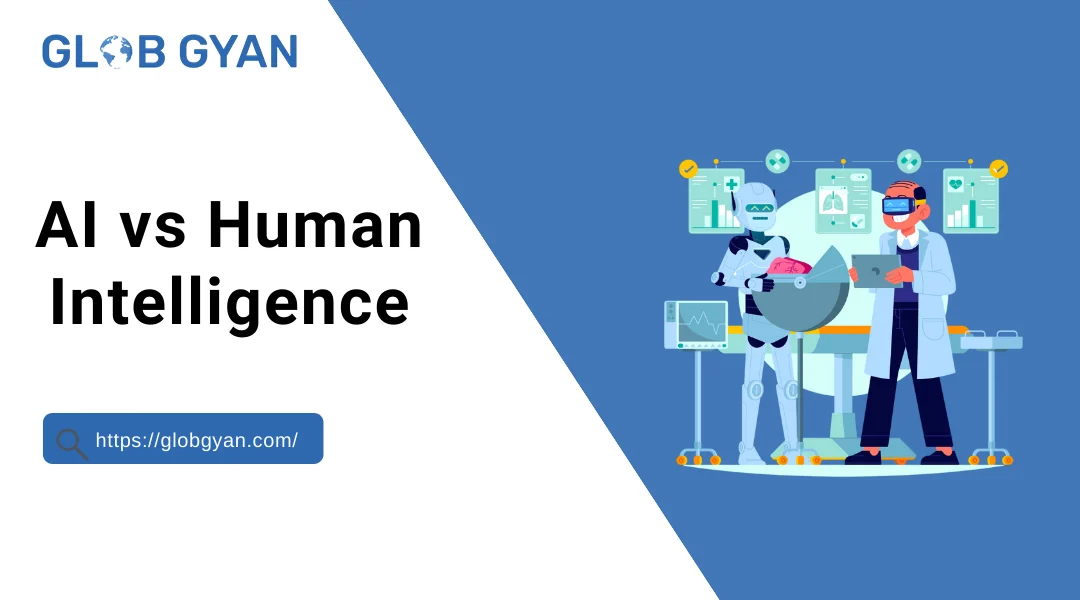
A few years ago, artificial intelligence sounded like something far away in the future. Now, it’s part of daily life. stored it’s getting product suggestions while shopping online or talking to a chatbot on a website, AI is already working quietly in the background. Because of this the topic of AI vs Human Intelligence is becoming more relevant than ever.
There’s a lot of noise around this topic. Some people think machines will replace humans. Others believe AI is just another tool like computers or the internet once were. When you really look closely at artificial intelligence vs human intelligence, you realize they are built for very different purposes.
The real conversation around ai vs human is not about who is smarter. It’s about where each one performs best and why both are needed.
What is Artificial Intelligence?
Artificial intelligence is basically technology that can perform tasks that normally need human thinking. It can learn from data, find patterns and help automate tasks.
Today, artificial intelligence and automation are helping businesses save time. Many companies now automate repetitive work like customer replies scheduling or data processing. This helps employees focus on creative or strategic tasks instead of routine work.
You might also hear the phrase human artificial intelligence. This simply means humans and AI working together. For example, AI can analyze customer behavior patterns, but humans still decide how to connect with customers emotionally.
AI works best in structured environments with lots of data. But when creativity or emotional understanding is needed, humans still have the advantage.
What is Human Intelligence?
Human intelligence is much more than logic or memory. It includes emotions, creativity, experiences and social understanding.
One of the biggest advantages of human intelligence is emotional awareness. Humans can understand tone, body language and context naturally. Machines can mimic responses but they don’t truly understand emotions.
When we compare human intelligence vs artificial intelligence, learning ability stands out. Humans can learn from a single mistake or experience. AI usually needs large amounts of data and repeated training.
Humans are also the reason AI exists in the first place. Every AI system was designed, trained and improved by human thinking.
AI vs Human Brain: How They Work Differently
When comparing AI vs human brain, it’s important to understand that both operate in completely different ways.
| Aspect | Human Brain | Artificial Intelligence (AI) |
| Processing System | Uses biological neurons to process information | Uses algorithms and computational models |
| Learning Style | Learns from real-life experiences and observations | Learns from training datasets and data patterns |
| Adaptability | Naturally adapts to new environments and situations | Needs reprogramming or retraining for new tasks |
| Intelligence Type | Uses emotional, social, and creative intelligence | Focuses mainly on logical and pattern-based intelligence |
| Speed & Flexibility | Slower in data processing but highly flexible and creative | Faster in data processing but limited in flexibility |
Difference Between AI and Human Intelligence
Let’s clearly understand the difference between AI and human intelligence using real-world comparisons.
| Aspect | Human Intelligence | Artificial Intelligence (AI) |
| Learning Ability | Learns from small experiences and daily interactions | Requires large amounts of data for learning |
| Creativity | Naturally creates original ideas and innovations | Can generate content but struggles with true originality |
| Emotional Understanding | Understands emotions, empathy, and social cues | Can only simulate emotional responses |
| Decision Making | Considers ethics, values, and context | Relies on programmed rules and data patterns |
| Adaptability | Easily adapts to unexpected situations | Needs reprogramming or retraining to adapt |
AI vs Human: Strengths Comparison
When comparing AI vs human, both have their own unique strengths that make them valuable in different areas.
| AI Strengths | Human Strengths |
| Fast data processing | Creativity and imagination |
| High accuracy in repetitive tasks | Emotional intelligence and empathy |
| Works 24/7 without fatigue | Ethical reasoning and moral judgment |
| Reduces human error | Complex and critical problem solving |
| Supports automation and efficiency | Social interaction and communication |
Advantages of Human Intelligence That Still Stand Strong
There are many advantages of human intelligence that machines still cannot fully match.
Humans build trust and relationships. They make moral decisions based on values and social understanding. These abilities are important in leadership, healthcare, education and business.
In the comparison of human intelligence vs artificial intelligence, adaptability is another major strength. Humans can adjust quickly to new situations.
Humans also create original ideas. Technology grows because of human imagination.
Human Artificial Intelligence Collaboration: The Future of Work
The future is not about machines replacing humans. It is about human artificial intelligence working together.
With the rise of artificial intelligence and automation, some job roles are changing. But new opportunities are also being created in AI development, data analysis and automation management.
People who learn how to work with AI tools instead of competing with them will have stronger career opportunities.
Artificial Intelligence and Automation in Daily Life and Business
Today, artificial intelligence and automation are present in almost every industry. Healthcare uses AI for data analysis. Finance uses AI for fraud detection. Businesses use AI to understand customer behavior.
However, humans still lead strategy, communication and final decision making. The modern workplace is becoming a balance between machine efficiency and human creativity.
The discussion around AI vs Human Intelligence is now more about partnership than replacement.
The Future of AI vs Human Intelligence
In the future, AI will continue improving. But human skills like empathy, creativity and leadership will remain important.
In the long-term discussion of artificial intelligence vs human intelligence, the most successful companies will be those that combine both strengths.
People who understand both technology and human behavior will be valuable in the future workforce.
Final Thoughts
The debate around AI vs Human Intelligence is not about choosing one over the other.
AI is powerful in speed and automation. Humans are powerful in creativity, emotions and decision making.
The future of ai vs human is collaboration. When human intelligence and artificial intelligence work together results become stronger and more effective.
FAQs
AI relies on data and algorithms to perform tasks, while human intelligence includes emotions, creativity, ethics and real-world understanding.
No. AI is faster at processing data, but humans are better at creativity, emotional understanding and complex decision-making.
AI can automate tasks, but it cannot replace human judgment, empathy or creativity. The future is collaboration, not replacement.
Automation handles repetitive tasks, while AI improves decisions inside those processes, making systems smarter and more efficient.
It refers to humans and AI working together where AI handles data and speed, and humans handle strategy, emotions, and ethics.
Human intelligence excels in creativity, adaptability, emotional awareness, leadership, and moral reasoning.
AI is stronger in fast data processing, accuracy, consistency and handling large-scale automation.
The future lies in collaboration, where AI supports human decision-making instead of replacing it.