




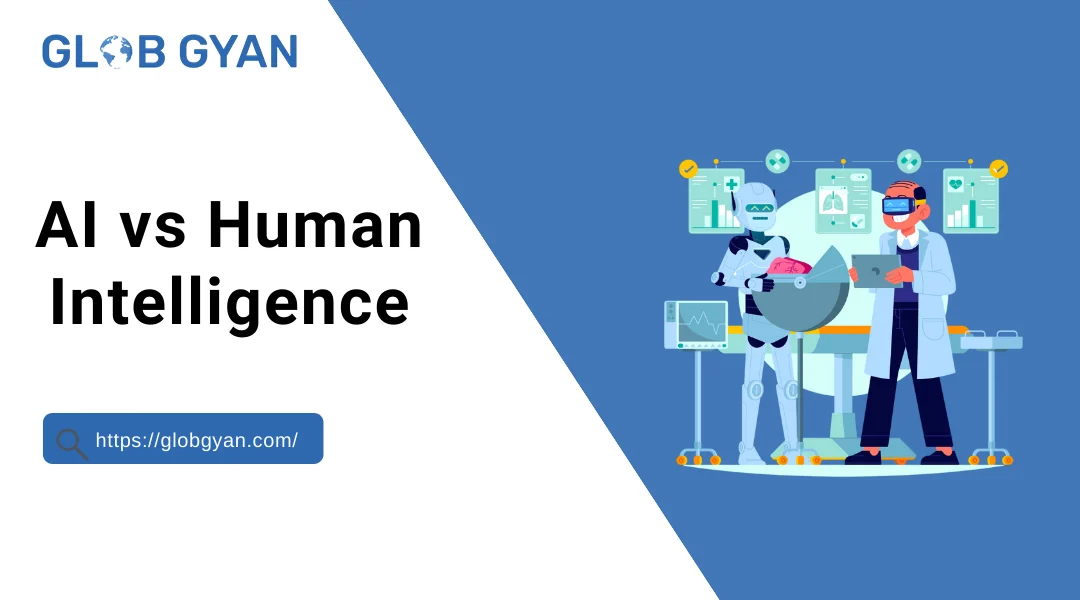
When people compare AI vs human intelligence, the conversation usually starts with the wrong question:
Which one is smarter?
It’s a tempting debate. After all, AI can beat world champions at chess, generate software code in seconds, and pass professional exams that require years of study. At the same time, humans can create art, build relationships, navigate uncertainty, and make sense of situations they’ve never encountered before.
But intelligence isn’t a single ability that can be measured on one scale.
The real question isn’t whether AI is smarter than humans. It’s what kind of thinking matters, in what situations, and why.
That’s where most discussions about AI vs Human Intelligence fall short.
Many articles reduce the comparison to a simple checklist: AI is faster, humans are more creative. AI has better memory, humans have emotions. While these differences are important, they barely scratch the surface of how intelligence actually works.
Human intelligence is not one thing. It involves intuition, reasoning, emotional awareness, social understanding, cultural learning, physical experience, and even the ability to think about our own thinking. Artificial intelligence is equally complex, ranging from machine learning models that recognize patterns to large language models capable of generating human-like conversations.
To understand the difference between AI and human intelligence, we need to look beyond speed, memory, and processing power. We need to explore how humans and machines learn, reason, make decisions, fail, adapt, and interact with the world around them.
In this guide, we’ll examine topics that most AI comparison articles ignore, including:
- How cognitive science explains human intelligence
- The difference between intuitive and analytical thinking
- Why embodied intelligence gives humans unique advantages
- Real-world benchmark data showing where AI beats humans and where it doesn’t
- How AI and humans fail in different ways under pressure
- The role of culture, experience, and context in shaping intelligence
- How AI is beginning to influence and reshape human cognition itself
By the end, you’ll have a much deeper understanding of artificial intelligence vs human intelligence not as a competition, but as two fundamentally different forms of intelligence with distinct strengths, weaknesses and limitations.
What Is Artificial Intelligence?
Artificial intelligence (AI) refers to computer systems that can perform tasks typically associated with human intelligence, such as learning from data, recognizing patterns, understanding language, solving problems, and making predictions.
At its core, AI works by processing large amounts of information through mathematical models and algorithms. Rather than thinking the way humans do, AI identifies patterns in data and uses those patterns to generate outputs, recommendations, or decisions.
This distinction is important because many discussions about AI vs Human Intelligence assume that AI thinks like a human. In reality, today’s AI systems operate very differently from the human mind.
AI Is Designed to Simulate Certain Cognitive Functions
Modern AI can perform tasks that resemble human cognitive abilities.
For example, AI can:
- Recognize faces in photographs
- Translate languages
- Generate written content
- Recommend products and movies
- Detect fraud and cybersecurity threats
- Analyze medical images
These capabilities may appear intelligent, but they are achieved through data processing, pattern recognition, and statistical prediction rather than conscious thought.
This is one of the fundamental differences in the artificial intelligence vs human intelligence debate. Humans understand meaning through experience and context, while AI identifies patterns within data.
Narrow AI vs General AI
One of the most overlooked distinctions in AI discussions is the difference between Narrow AI and Artificial General Intelligence (AGI).
Narrow AI (The AI We Have Today)
Nearly every AI system currently in use falls into the category of Narrow AI.
Narrow AI is designed to perform specific tasks exceptionally well.
Examples include:
- ChatGPT generating text
- Recommendation engines suggesting products
- Navigation apps finding routes
- AI image generators creating artwork
- Voice assistants answering questions
These systems can be highly capable within their area of expertise, but they cannot transfer knowledge across unrelated tasks the way humans can.
An AI that excels at writing articles cannot automatically drive a car or diagnose a disease.
Artificial General Intelligence (AGI)
Artificial General Intelligence refers to a theoretical form of AI that could understand, learn, and apply knowledge across a wide variety of tasks, much like a human being.
AGI would be capable of:
- Learning new skills independently
- Adapting to unfamiliar situations
- Reasoning across domains
- Solving novel problems without specialized training
Despite frequent headlines, AGI does not yet exist. Current AI systems remain highly specialized compared to human intelligence.
Core Capabilities of Modern AI
Although AI systems vary widely, most are built around several key capabilities.
Pattern Recognition
Pattern recognition is one of AI’s greatest strengths.
Machine Learning systems can identify relationships within enormous datasets that would be difficult for humans to detect.
Examples include:
- Fraud detection
- Medical image analysis
- Product recommendations
- Predictive maintenance
Natural Language Processing
Natural Language Processing (NLP) allows AI systems to work with human language.
This technology powers:
- Chatbots
- Virtual assistants
- Language translation tools
- AI writing assistants
Modern Large Language Models use NLP to generate human-like responses, summarize information, and answer questions.
Prediction and Forecasting
AI systems are exceptionally effective at making predictions based on historical data.
Examples include:
- Demand forecasting
- Weather prediction
- Financial risk analysis
- Customer behavior modeling
Automation
AI can automate repetitive tasks that traditionally required human effort.
Examples include:
- Data entry
- Customer support workflows
- Content categorization
- Manufacturing processes
This ability to automate routine work is one of the biggest advantages of AI over humans in many business environments.
What AI Is Not
One of the biggest misconceptions surrounding artificial intelligence is the belief that modern AI possesses human-like awareness.
It doesn’t.
Despite impressive capabilities, current AI systems do not have:
- Consciousness
- Self-awareness
- Intentions
- Emotions
- Personal experiences
- Genuine understanding
An AI chatbot may appear to understand a conversation, but it does not experience the conversation the way a person does.
It does not feel curiosity.
It does not have beliefs.
It does not possess goals unless they are explicitly programmed.
This distinction becomes critical when discussing the difference between AI and human intelligence.
Humans think about their own thoughts, reflect on past experiences, and develop personal identities. Current AI systems do none of these things.
How Large Language Models Work
Many of today’s most advanced AI systems are powered by Large Language Models (LLMs).
These models are trained on vast amounts of text collected from books, websites, articles, and other sources.
During training, the system learns statistical relationships between words, phrases, and concepts.
When you ask an AI assistant a question, it does not search for a pre-written answer. Instead, it predicts the most likely sequence of words based on patterns learned during training.
Most modern LLMs use a technology called the Transformer architecture, which helps them understand relationships between words and context across large amounts of text.
The result is a system capable of generating surprisingly coherent responses.
However, predicting language is not the same as understanding it.
This is why AI can sometimes provide brilliant answers and, in other situations, generate incorrect or misleading information with complete confidence.
AI Is Not One Technology
Another common mistake is treating AI as a single technology.
In reality, AI is an umbrella term that covers many different fields and applications.
Some of the major categories include:
| AI Category | What It Does | Example |
| Machine Learning | Learns patterns from data | Fraud detection |
| Computer Vision | Interprets images and video | Facial recognition |
| Natural Language Processing | Understands and generates language | ChatGPT |
| Robotics | Enables physical interaction with environments | Warehouse robots |
| Recommendation Systems | Predicts user preferences | Netflix recommendations |
Each category solves different problems and uses different techniques.
When comparing AI vs Human Intelligence, it’s important to remember that there is no single AI system that performs all of these functions simultaneously.
What Is Human Intelligence? It’s More Than You Think
Before comparing artificial intelligence and human intelligence, it’s important to understand a simple fact:
Human intelligence is not a single ability.
Many people associate intelligence with IQ scores, academic performance, or problem-solving skills. While those factors matter, they represent only a small part of what makes human intelligence unique.
In reality, human intelligence is the cognitive capacity to learn, reason, adapt, communicate, create, solve problems, and navigate the world. It is shaped not only by the brain but also by emotions, physical experiences, social relationships, culture, and millions of years of evolution.
This broader perspective is essential for understanding the true difference between AI and human intelligence.
While AI systems are often evaluated using performance metrics such as accuracy, speed, and data processing capabilities, human intelligence cannot be reduced to a single score or benchmark.
Human Intelligence Is a Portfolio of Capabilities
One reason the AI vs Human Intelligence debate is often oversimplified is that people treat intelligence as if it were one measurable thing.
Psychologist Howard Gardner challenged this idea with his theory of Multiple Intelligences.
According to Gardner, human intelligence consists of several distinct but interconnected forms of intelligence.
Howard Gardner’s Multiple Intelligences
Linguistic Intelligence
The ability to use language effectively through speaking, writing, storytelling, and communication.
Examples include:
- Authors
- Journalists
- Public speakers
- Lawyers
Logical-Mathematical Intelligence
The ability to analyze problems, recognize patterns, and work with numbers and logic.
Examples include:
- Scientists
- Engineers
- Mathematicians
- Programmers
This is the area where AI often performs exceptionally well because many tasks involve structured reasoning and pattern recognition.
Spatial Intelligence
The ability to visualize objects, environments, and relationships in three-dimensional space.
Examples include:
- Architects
- Designers
- Pilots
- Surgeons
Humans use spatial intelligence constantly when navigating unfamiliar environments or mentally rotating objects.
Musical Intelligence
The ability to recognize rhythm, melody, pitch, and musical patterns.
Examples include:
- Musicians
- Composers
- Conductors
While AI can generate music, human musicians often combine technical skill with emotional expression and cultural understanding.
Bodily-Kinesthetic Intelligence
The ability to control physical movements with precision and coordination.
Examples include:
- Athletes
- Dancers
- Craftspeople
- Surgeons
This form of intelligence highlights something many AI discussions ignore: intelligence is not limited to the brain.
Interpersonal Intelligence
The ability to understand other people’s emotions, motivations, intentions, and behaviors.
Examples include:
- Teachers
- Managers
- Therapists
- Negotiators
Strong interpersonal intelligence allows humans to build trust, resolve conflicts, and collaborate effectively.
Intrapersonal Intelligence
The ability to understand oneself.
This includes:
- Self-awareness
- Emotional regulation
- Reflection
- Personal growth
Humans can examine their own thoughts, evaluate their behavior, and adjust their actions accordingly.
Current AI systems do not possess this capability.
Naturalist Intelligence
The ability to recognize patterns in nature and understand relationships within the natural world.
Examples include:
- Biologists
- Farmers
- Environmental scientists
For most of human history, this type of intelligence played a critical role in survival.
Why Multiple Intelligences Matter in the AI Debate
The theory of multiple intelligences highlights a problem with many comparisons between humans and machines.
When people ask whether AI is smarter than humans, they are often focusing on only one type of intelligence—usually logical reasoning or information processing.
But human intelligence includes many other abilities:
- Emotional awareness
- Social understanding
- Creativity
- Physical coordination
- Self-reflection
- Adaptability
This makes the artificial intelligence vs human intelligence comparison far more complicated than a simple contest of computational power.
Emotional Intelligence: The Missing Piece in Most AI Comparisons
One of the most important forms of human intelligence is emotional intelligence, often called EQ.
Emotional intelligence refers to the ability to:
- Recognize emotions
- Understand emotional signals
- Manage feelings effectively
- Respond appropriately to others
A manager resolving workplace conflict, a doctor comforting a patient, or a parent supporting a child all rely heavily on emotional intelligence.
These situations require more than logic.
They require empathy, social awareness, and emotional understanding.
This remains one of the biggest advantages of human intelligence over current AI systems.
Although AI can recognize emotional patterns and generate empathetic responses, it does not genuinely experience emotions.
An AI assistant can identify signs of frustration in a message.
A human can actually feel compassion.
That distinction matters.
Intelligence Doesn’t Just Live in the Brain
Another concept often overlooked in discussions about AI is embodied cognition.
Traditional views assume that intelligence exists entirely inside the brain.
Modern cognitive science suggests something different.
Many forms of intelligence emerge through interaction between the brain, body, and environment.
Think about:
- Riding a bicycle
- Catching a ball
- Performing surgery
- Playing a musical instrument
- Driving a car
These activities rely on physical experience, sensory feedback, muscle memory, and real-time adjustments.
This is known as embodied intelligence.
For example, an experienced carpenter can often feel when a material is slightly misaligned before measuring it.
A professional athlete can react to changing conditions almost instantly without consciously analyzing every movement.
This type of intelligence develops through years of physical interaction with the world.
Most AI systems have no equivalent experience.
Even advanced machine learning models do not directly experience touch, balance, movement, pain, temperature, or physical effort.
This remains one of the most significant differences between human intelligence and machine intelligence.
Human Intelligence Was Built for Survival, Not Perfect Logic
One of the most important insights from evolutionary psychology is that human intelligence was not designed to maximize performance on tests or benchmarks.
It evolved to help humans survive.
Our ancestors needed to:
- Identify threats
- Cooperate with groups
- Raise children
- Find resources
- Adapt to changing environments
As a result, human intelligence prioritizes flexibility, social cooperation, and adaptability.
This evolutionary history explains why people sometimes make irrational decisions.
Many of the mental shortcuts we use today developed because they helped our ancestors make quick decisions in uncertain environments.
These shortcuts are known as cognitive biases.
While biases can lead to errors, they are also part of what makes human decision-making fast and efficient.
Understanding these trade-offs provides a deeper perspective on the difference between human and artificial intelligence.
Why Human Intelligence Is Difficult to Replicate
When viewed through the lens of psychology, neuroscience, and evolution, human intelligence becomes far more complex than many people realize.
Humans do not simply process information.
They:
- Feel emotions
- Form relationships
- Learn through experience
- Develop self-awareness
- Adapt to unfamiliar situations
- Build cultural knowledge across generations
Artificial intelligence can replicate certain aspects of cognition, particularly pattern recognition and data processing.
However, human intelligence is a rich combination of reasoning, emotion, embodiment, culture, memory, and social understanding.
This is why the question is not simply whether AI can outperform humans.
The more important question is:
Which type of intelligence are we talking about?
The answer often determines whether humans, machines, or a combination of both have the advantage.
AI vs Human Intelligence: The Core Differences Explained
The debate around AI vs Human Intelligence often focuses on one question: which is better?
The answer depends entirely on what kind of intelligence we’re talking about.
Artificial intelligence and human intelligence are both capable of solving problems, processing information, and making decisions. However, they achieve these outcomes in fundamentally different ways.
AI relies on data, algorithms, and computational models. Human intelligence emerges from biology, experience, emotions, culture, social interaction, and physical engagement with the world.
The table below highlights some of the most important differences between artificial intelligence and human intelligence.
AI vs Human Intelligence Comparison Table
| Dimension | AI | Human Intelligence |
| Learning Method | Learns from training datasets and algorithms | Learns from experience, environment, observation, and social interaction |
| Speed & Scale | Processes vast amounts of data extremely quickly | Slower processing, limited working memory |
| Creativity | Recombines existing patterns within training data | Generates novel ideas from imagination and experience |
| Emotional Understanding | Simulates emotions through pattern recognition | Experiences genuine emotions that influence thinking |
| Adaptability | Requires retraining or additional data for major changes | Adapts continuously to new situations and environments |
| Metacognition | Cannot genuinely evaluate its own reasoning process | Can reflect on, question, and modify its own thinking |
| Confidence Calibration | May generate incorrect answers with high confidence | Often signals uncertainty and seeks additional information |
| Cultural Context | Limited by training data and representation | Deeply shaped by culture, language, and lived experience |
| Error Pattern | Systematic errors caused by data or model limitations | Variable errors caused by bias, fatigue, stress, or emotion |
| Physical Intelligence | No direct embodied experience | Learns through movement, touch, sensory feedback, and physical interaction |
While this table provides a useful overview, some of the most important differences become clear only when we examine how humans and AI think beneath the surface.
The Metacognition Gap: Humans Can Think About Their Thinking
One of the most significant differences between human intelligence and artificial intelligence is metacognition.
Metacognition simply means “thinking about thinking.”
Humans constantly evaluate their own reasoning processes.
For example, when solving a difficult problem, a person might stop and ask:
- Am I approaching this correctly?
- What assumptions am I making?
- Could there be another explanation?
- Am I solving the right problem?
This ability allows people to reconsider their conclusions, adjust strategies, and learn from mistakes.
Current AI systems do not possess true metacognition.
An AI model can generate explanations about its reasoning process, but it does not genuinely understand or inspect its own thoughts because it does not have conscious awareness of them.
This distinction becomes especially important in complex environments where asking the right question is often more valuable than producing a quick answer.
In many cases, human intelligence excels not because it always finds the correct solution, but because it can recognize when it may be solving the wrong problem altogether.
Confidence Calibration: Why Humans Say “I Don’t Know”
Another overlooked difference between AI and human intelligence involves confidence calibration.
Humans regularly communicate uncertainty.
When faced with limited information, people often say:
- “I’m not sure.”
- “I could be wrong.”
- “I need more information.”
These responses help prevent mistakes and encourage further investigation.
AI systems operate differently.
Large Language Models generate responses based on probabilities and patterns in training data. As a result, they can sometimes produce information that sounds accurate and convincing even when it is completely incorrect.
This phenomenon is known as an AI hallucination.
For example, an AI assistant might confidently generate a non-existent research study, invent a source, or provide inaccurate facts while presenting them as if they were true.
This is one of the most important AI limitations compared to humans.
Humans certainly make mistakes, but they often have an intuitive sense of uncertainty. AI systems frequently lack this natural ability to communicate doubt reliably.
Creativity: Recombination vs Original Creation
Creativity is another area where the difference between AI and human intelligence becomes apparent.
Modern Generative AI can create:
- Articles
- Images
- Videos
- Music
- Marketing campaigns
The quality can be impressive.
However, AI creativity is largely based on recombination. It identifies patterns from existing information and generates new outputs by combining those patterns in novel ways.
Human creativity often works differently.
A scientist proposing a new theory, an entrepreneur inventing a business model, or an artist creating a new style draws from personal experiences, emotions, intuition, and cultural influences.
Humans create not only from information but also from meaning.
This remains one of the strongest advantages of human intelligence.
Cultural Context: Intelligence Doesn’t Exist in a Vacuum
Human intelligence is deeply embedded in culture.
People learn through:
- Family traditions
- Social norms
- Language
- Historical experiences
- Shared values
A joke that makes perfect sense in one culture may be completely misunderstood in another.
Humans naturally navigate these contextual layers because they grow up within them.
AI systems learn from training data rather than lived experience.
As a result, they may misunderstand cultural references, overlook regional differences, or reflect biases present in their training datasets.
This is why cultural understanding remains a major challenge in the development of advanced AI systems.
Embodied Intelligence: What Humans Know Through Experience
Perhaps the most underrated difference between human intelligence and machine intelligence is embodied intelligence.
Many forms of knowledge do not exist solely in the brain.
They exist in the body.
Consider:
- A surgeon performing a delicate operation
- A carpenter sensing when a piece of wood is slightly uneven
- A professional athlete adjusting balance in real time
- A musician playing an instrument without consciously thinking about every movement
These abilities depend on years of physical interaction with the world.
Humans learn through touch, movement, sensory feedback, and muscle memory.
This type of intelligence cannot be fully captured through text, images, or datasets alone.
AI can analyze descriptions of these activities, but it does not experience them.
It has never felt resistance while carving wood, adjusted balance on a bicycle, or sensed subtle changes through physical contact.
This embodied aspect of cognition is one reason many researchers believe human intelligence remains fundamentally different from artificial intelligence.
Where AI Genuinely Outperforms Human Intelligence
The debate around AI vs Human Intelligence often focuses on what machines cannot do.
AI lacks emotions.
AI lacks self-awareness.
AI lacks lived experience.
All of that is true.
However, focusing only on AI’s limitations misses an equally important reality: in certain domains, artificial intelligence already performs better than humans.
Not slightly better.
Significantly better.
The reason is simple. AI and human intelligence evolved for different purposes.
Human intelligence developed to help our ancestors survive, cooperate, communicate, and adapt in unpredictable environments.
AI was built to process information, recognize patterns, and perform computational tasks at scales that humans simply cannot match.
Understanding these strengths is essential to having an honest conversation about artificial intelligence vs human intelligence.
Speed and Scale: AI Operates Beyond Human Limits
Perhaps the most obvious advantage of AI is speed.
A person can read a report.
An AI system can analyze millions of reports.
A financial analyst might review hundreds of transactions during a workday. An AI-powered fraud detection system can evaluate millions of transactions in real time.
A doctor can review dozens of scans in a day. AI systems can analyze thousands.
This ability to process enormous volumes of information is one of the biggest advantages of AI over humans.
The difference isn’t just quantitative.
At a certain scale, tasks become impossible for humans but routine for AI.
No matter how intelligent a person is, there are physical limits to attention, memory, and time.
AI operates under a completely different set of constraints.
Consistency: AI Doesn’t Get Tired
Humans are remarkably adaptable, but they are not perfectly consistent.
Performance changes throughout the day.
People become:
- Fatigued
- Distracted
- Stressed
- Emotionally affected
Even experts make mistakes after long hours of repetitive work.
AI systems do not experience these fluctuations.
The thousandth image analyzed by an AI model receives the same level of attention as the first.
The ten-thousandth customer inquiry is handled using the same process as the hundredth.
This consistency makes AI particularly valuable in environments where accuracy and repetition matter.
Examples include:
- Quality control
- Manufacturing
- Fraud monitoring
- Data classification
- Medical screening
While AI can still make mistakes, those mistakes are generally systematic rather than caused by exhaustion or loss of concentration.
Pattern Recognition in Massive Datasets
One of AI’s greatest strengths is finding patterns hidden within large amounts of data.
Humans are good at recognizing patterns.
AI can recognize patterns at a scale humans cannot approach.
This capability powers many modern applications, including:
Medical Imaging
AI systems can identify subtle abnormalities in medical scans that may be difficult for humans to detect consistently.
In specific imaging tasks such as retinal screening and certain radiology applications, AI systems have demonstrated performance comparable to or exceeding specialist-level accuracy.
This does not mean doctors are obsolete.
Instead, AI functions as a powerful diagnostic assistant, helping physicians identify potential issues more quickly and accurately.
Fraud Detection
Banks process millions of transactions every day.
Detecting suspicious behavior manually would be nearly impossible.
Machine Learning systems continuously monitor transactions and identify unusual patterns that may indicate fraud.
Predictive Analytics
Businesses use AI to predict:
- Customer behavior
- Equipment failures
- Market trends
- Supply chain disruptions
These predictions are possible because AI can analyze relationships across enormous datasets in ways humans cannot practically replicate.
Memory: AI Never Forgets
Human memory is extraordinary, but it is far from perfect.
People forget:
- Names
- Dates
- Facts
- Details
- Conversations
Memory is reconstructive, meaning people often remember events imperfectly.
AI systems operate differently.
Information stored within databases can be retrieved instantly and consistently.
Modern AI can reference and process vast amounts of information without the natural memory limitations humans face.
This gives AI a major advantage in information-intensive environments such as:
- Research
- Knowledge management
- Technical documentation
- Legal document review
However, it’s worth noting that memory and understanding are not the same thing.
An AI may retrieve information perfectly while still lacking true comprehension of its meaning.
Availability: AI Works Around the Clock
Humans require:
- Sleep
- Breaks
- Recovery
- Time away from work
AI does not.
A customer support chatbot can assist users at 3 a.m.
A cybersecurity system can monitor threats continuously.
A recommendation engine can process requests every second of the day.
This 24/7 availability provides significant operational advantages for organizations that need constant service and monitoring.
It is one reason AI has become deeply integrated into modern digital infrastructure.
Cross-Domain Knowledge Synthesis
Another emerging advantage of AI is its ability to analyze information across multiple disciplines simultaneously.
A human researcher may spend years reviewing literature in a single field.
AI can rapidly analyze and summarize information from thousands of papers spanning different disciplines.
This capability helps researchers identify:
- Hidden relationships
- Emerging trends
- Potential research directions
- Interdisciplinary connections
For example, an AI system might identify links between biological research, chemistry studies, and medical literature that would take a human team months or years to uncover.
This does not replace scientific expertise, but it significantly expands what researchers can realistically analyze.
Domains Where AI Already Exceeds Human Performance
The strongest evidence in the AI vs Human Intelligence debate comes from real-world benchmarks.
There are now several domains where AI clearly outperforms humans.
Chess
Modern chess engines consistently defeat even the strongest human grandmasters.
The gap has become so large that humans no longer compete directly with top chess engines on equal terms.
Go
Go was once considered one of the most difficult games for computers because of its enormous number of possible moves.
That changed when AI systems demonstrated superhuman performance against world-class players.
Protein Folding
One of the most significant scientific achievements in recent AI history came from AlphaFold.
Protein folding had challenged researchers for decades because predicting protein structures is extraordinarily complex.
AlphaFold dramatically improved prediction accuracy and accelerated biological research in ways many scientists considered transformative.
This is a powerful example of AI contributing not just to efficiency but to scientific discovery itself.
Certain Diagnostic Tasks
In specific areas of medical image analysis, AI systems can match or exceed specialist-level performance.
These systems are particularly effective when:
- Large training datasets exist
- Clear patterns can be identified
- Decisions rely heavily on visual analysis
However, diagnosis remains only one part of healthcare. Human doctors still provide judgment, communication, empathy, and contextual decision-making.
Why AI’s Strengths Don’t Mean Human Intelligence Is Obsolete
Looking at these examples, it may seem like AI is steadily replacing human intelligence.
That conclusion misses an important point.
Most of AI’s greatest successes occur in environments that are:
- Data-rich
- Structured
- Measurable
- Pattern-driven
Human intelligence evolved to solve a different set of problems.
Humans excel in environments that require:
- Creativity
- Social understanding
- Adaptability
- Moral judgment
- Contextual reasoning
The lesson isn’t that AI is better than humans.
The lesson is that AI and human intelligence are optimized for different challenges.
The organizations, researchers, and professionals achieving the best results today are not choosing between humans and AI.
They are combining the strengths of both.
That partnership is likely to define the future of intelligence far more than any competition between machines and people.
Where Human Intelligence Remains Irreplaceable
As AI systems become more capable, it’s tempting to view intelligence as a competition.
AI beats humans at chess.
AI analyzes medical images.
AI generates software code.
AI writes articles.
Yet focusing only on performance benchmarks can obscure a more important question:
What kinds of intelligence are uniquely human?
The answer extends far beyond creativity or empathy.
Human intelligence is deeply connected to self-awareness, lived experience, culture, embodiment, morality, and millions of years of evolutionary adaptation. These dimensions shape how people understand the world, make decisions, and navigate uncertainty.
While AI excels at data processing and pattern recognition, there are several areas where human intelligence remains fundamentally different—and, at least for now, irreplaceable.
Metacognition: The Ability to Think About Thinking
One of the most powerful aspects of human intelligence is metacognition.
Simply put, metacognition is the ability to think about your own thinking.
Humans routinely step back and ask questions such as:
- Am I making the wrong assumption?
- Is there a better way to approach this problem?
- What information am I missing?
- Am I even solving the right problem?
This ability allows people to question goals, reframe challenges, and change direction when necessary.
Imagine a company trying to increase sales.
An AI system may optimize advertising campaigns, improve targeting, and generate marketing content based on the objective it receives.
A human strategist might ask something entirely different:
“What if declining sales aren’t the problem? What if customer trust is the real issue?”
That shift in perspective can completely redefine the solution.
This illustrates one of the most important differences between AI and human intelligence.
AI is designed to optimize for a given goal.
Humans can question whether the goal itself is correct.
This ability to challenge assumptions is often the source of breakthrough discoveries, innovations, and strategic decisions.
Embodied and Tacit Knowledge: Intelligence That Lives in the Body
Many discussions about intelligence assume knowledge exists only in the brain.
In reality, some of the most valuable human knowledge cannot be easily written down, measured, or explained.
Philosopher Michael Polanyi described this idea through the concept of tacit knowledge, summarized by his famous observation:
“We know more than we can tell.”
Consider a master surgeon performing a delicate procedure.
The surgeon may struggle to describe every tiny adjustment made during an operation.
Yet years of experience have developed a deep intuitive understanding that guides each movement.
The same principle applies to:
- A potter shaping clay
- A jazz musician improvising during a performance
- A firefighter navigating a dangerous environment
- A professional athlete reacting instantly to changing conditions
- An experienced carpenter sensing subtle imperfections in wood
These abilities rely on embodied intelligence.
Knowledge develops through:
- Physical interaction
- Sensory feedback
- Muscle memory
- Repeated practice
- Real-world experience
This is not simply skill.
It is a form of intelligence that emerges from the relationship between the brain, body, and environment.
Most AI systems have no equivalent experience.
An AI can analyze descriptions of surgery or music, but it has never felt the resistance of tissue during an operation or the rhythm of a live performance.
This embodied dimension remains one of the clearest examples of the difference between human intelligence and machine intelligence.
Cultural and Contextual Intelligence
Human communication is rarely literal.
Meaning often depends on:
- Culture
- History
- Relationships
- Shared experiences
- Social norms
Consider the phrase:
“That’s interesting.”
Depending on the context, it could mean:
- Genuine curiosity
- Polite disagreement
- Skepticism
- Disappointment
- Subtle criticism
Most humans instinctively understand these nuances because they have spent years immersed in cultural and social environments.
This type of contextual intelligence is extraordinarily difficult to replicate.
Although AI systems have become better at understanding language, they often struggle with:
- Irony
- Sarcasm
- Cultural references
- Regional expressions
- Social expectations
These limitations become particularly important in real-world applications.
For example:
- Customer service interactions
- Medical guidance
- Legal advice
- Educational support
- International communication
An AI system trained primarily on English-language and Western-centric data may misunderstand situations that a culturally fluent human would interpret correctly.
This is one reason human oversight remains essential in many high-stakes environments.
Moral and Ethical Reasoning Under Uncertainty
One of the most overlooked aspects of human intelligence is moral judgment.
Ethical decisions rarely involve simple right-or-wrong answers.
Instead, they often require balancing competing values.
Imagine a doctor deciding how to allocate limited medical resources.
Or a judge weighing justice against compassion.
Or a business leader choosing between profitability and employee well-being.
These situations involve uncertainty, trade-offs, and moral complexity.
Humans navigate these decisions by considering:
- Context
- Consequences
- Values
- Empathy
- Social responsibility
Importantly, humans also experience the emotional weight of these choices.
They feel responsibility.
They experience doubt.
They can be held accountable for their actions.
AI operates differently.
An AI system can apply rules, optimize objectives, and generate recommendations.
But it does not experience moral conflict.
It does not carry responsibility for outcomes.
It cannot genuinely understand what it means to make a difficult ethical choice.
This distinction is at the heart of many modern debates about AI ethics.
The challenge is not whether AI can make decisions.
The challenge is whether decision-making can ever be separated from moral responsibility.
Evolutionary Wisdom: When Human “Bugs” Are Actually Features
Humans are often criticized for being irrational.
Psychologists have documented dozens of cognitive biases that influence decision-making.
Examples include:
- Loss aversion
- Confirmation bias
- Social proof
- In-group preference
- Availability bias
At first glance, these biases appear to be flaws.
However, evolutionary psychology offers a different perspective.
Many of these tendencies evolved because they helped humans survive in uncertain environments.
For example:
Loss Aversion
People tend to fear losses more than they value equivalent gains.
This bias may seem irrational in financial markets.
Yet in dangerous environments, avoiding catastrophic losses often mattered more than maximizing rewards.
Social Proof
Humans frequently follow group behavior.
While this can sometimes lead to poor decisions, it also helped our ancestors cooperate, share information, and survive collectively.
In-Group Preference
People naturally form strong social bonds with trusted groups.
Although this tendency can create challenges in modern societies, it historically strengthened cooperation and protection within communities.
In other words, many human “errors” are not random mistakes.
They are heuristics shaped by millions of years of evolutionary pressure.
The apparent irrationality of human intelligence often contains hidden wisdom that makes sense within specific contexts.
The Hidden Risk Nobody Talks About: How AI Is Changing Human Intelligence
Most discussions about AI vs Human Intelligence assume that humans and AI are separate systems competing against each other.
Humans think.
AI computes.
Humans create.
AI assists.
But that framing is becoming increasingly outdated.
The reality is that AI is no longer just a tool we use. It is becoming part of how we think.
This shift raises a fascinating question:
What happens when artificial intelligence doesn’t replace human intelligence but becomes integrated into it?
The answer may be one of the most important cognitive and societal challenges of the next decade.
Intelligence Has Always Extended Beyond the Brain
At first glance, intelligence appears to exist entirely inside our heads.
Yet humans have always relied on external tools to think more effectively.
Consider:
- Writing systems
- Books
- Calculators
- Maps
- Search engines
- Smartphones
These tools allow us to store information, solve problems, and make decisions beyond the natural limits of memory and attention.
Cognitive scientists sometimes describe this phenomenon as extended cognition or distributed cognition.
The basic idea is simple:
Part of our thinking occurs outside the brain.
When you save a phone number in your contacts instead of memorizing it, your cognitive system now includes your phone.
When a pilot relies on navigation instruments, intelligence is distributed between the human and the technology.
AI represents the next stage of this process.
Instead of simply storing information, AI can now help generate ideas, summarize knowledge, identify patterns, and support decision-making.
In many situations, intelligence is no longer entirely human or entirely artificial.
It is becoming a hybrid system.
The Augmentation Opportunity: AI Can Expand Human Intelligence
Much of the public conversation focuses on whether AI will replace people.
A more useful question is:
How can AI make people better at what they already do?
Some of the most successful applications of AI involve augmentation rather than automation.
Healthcare
AI-assisted radiologists can analyze medical images more efficiently and identify abnormalities that might otherwise be overlooked.
The goal is not to replace doctors.
The goal is to combine machine precision with human judgment.
Scientific Research
Researchers face an overwhelming volume of published studies.
No individual can read everything.
AI systems can summarize literature, identify patterns across thousands of papers, and surface relevant findings more quickly.
This allows researchers to spend more time on interpretation, experimentation, and discovery.
Writing and Creative Work
Writers increasingly use AI to:
- Generate ideas
- Explore alternative perspectives
- Draft outlines
- Overcome creative blocks
Rather than replacing creativity, AI can expand the range of possibilities a person considers.
In these examples, AI functions as a cognitive amplifier.
The combination of human intelligence and artificial intelligence often outperforms either one operating alone.
The Atrophy Risk: What Happens When We Stop Practicing?
Every technology changes how people think.
The calculator changed mental arithmetic.
GPS changed navigation.
Search engines changed information retrieval.
AI may influence an even broader range of cognitive skills.
Researchers studying cognitive offloading have long observed that people tend to rely on external systems when those systems are convenient and reliable.
This is not necessarily a problem.
The challenge arises when offloading becomes dependence.
Consider a future where people routinely rely on AI for:
- Writing
- Research
- Problem-solving
- Memory recall
- Decision-making
- Mathematical reasoning
Over time, some skills may weaken simply because they are used less frequently.
This does not mean AI is harmful.
It means that cognitive abilities, like muscles, often improve through use and deteriorate through neglect.
The risk is not that AI makes people less intelligent.
The risk is that certain forms of intelligence become underdeveloped because AI performs them so effectively.
The Verification Problem: Trust Is Becoming a Cognitive Skill
One of the biggest challenges of the AI era is not generating information.
It is evaluating information.
AI systems often produce answers that sound confident and authoritative.
Sometimes those answers are excellent.
Sometimes they are incorrect.
As AI becomes more integrated into education, business, and daily life, a subtle risk emerges:
People may begin accepting AI-generated outputs without independent verification.
This creates what some researchers call a calibration problem.
The challenge is not simply whether AI is right or wrong.
The challenge is knowing when to trust it.
A person who automatically rejects AI advice may miss valuable insights.
A person who automatically accepts AI advice may overlook serious errors.
The most effective users of AI are neither skeptics nor believers.
They are evaluators.
They treat AI as a collaborator whose work still requires critical review.
Why Critical Thinking Matters More Than Ever
A common assumption is that AI will make critical thinking less important.
The opposite may be true.
When information becomes easier to generate, the value shifts toward evaluating information.
When answers become abundant, asking better questions becomes more important.
When AI can produce dozens of possible solutions, human judgment determines which solution actually matters.
In an AI-augmented world, some of the most valuable skills may include:
- Critical thinking
- Source verification
- Contextual reasoning
- Ethical judgment
- Creativity
- Decision-making under uncertainty
These abilities help people determine not just whether something can be done, but whether it should be done.
The Future Belongs to People Who Can Think Alongside AI
Many conversations focus on learning how to use AI tools.
That is certainly important.
However, the deeper challenge is learning how to think alongside AI without surrendering independent judgment.
Future professionals will need more than technical skills.
They will need the ability to:
- Collaborate with intelligent systems
- Challenge AI-generated assumptions
- Recognize limitations and biases
- Verify outputs
- Make decisions in ambiguous situations
In other words, the most valuable skill may not be AI expertise.
It may be the ability to combine human intelligence and artificial intelligence effectively while preserving the strengths that make human thinking unique.
AI vs Human Intelligence in the Workplace: What Actually Matters
Much of the discussion around AI vs Human Intelligence eventually comes down to one practical question:
What does this mean for work?
For years, headlines have focused on whether AI will replace jobs.
While job displacement is a legitimate concern, the more useful question is not whether AI will replace people.
It’s which tasks are best performed by AI, which require human intelligence, and how the two can work together.
The workplace is not becoming a competition between humans and machines.
It is becoming an environment where success increasingly depends on understanding the strengths and limitations of both.
Which Jobs Are Most Affected by AI?
AI performs best in environments that involve:
- Large volumes of data
- Repetitive workflows
- Pattern recognition
- Structured decision-making
- Predictable outputs
As a result, jobs containing these types of tasks are experiencing the greatest impact.
Examples include:
Data Processing and Analysis
AI can rapidly:
- Organize information
- Detect patterns
- Generate reports
- Identify anomalies
- Produce forecasts
Tasks that once required hours of manual work can now be completed in minutes.
Administrative Work
Many routine office tasks can be automated, including:
- Scheduling
- Document classification
- Data entry
- Email drafting
- Meeting summaries
Templated Writing
Generative AI excels at producing content based on existing structures.
Examples include:
- Product descriptions
- Routine reports
- Customer support responses
- Basic marketing copy
- Technical summaries
This does not eliminate the need for human writers, but it changes how writing work is performed.
The common theme is simple:
The more predictable and repeatable a task is, the greater the advantage of artificial intelligence.
Which Jobs Are Most Resilient?
The jobs least vulnerable to automation tend to rely on forms of intelligence that AI struggles to replicate.
These include:
Embodied Skills
Many professions require physical judgment and sensory experience.
Examples include:
- Surgeons
- Electricians
- Plumbers
- Mechanics
- Skilled craftspeople
These roles depend on embodied intelligence, real-world feedback, and hands-on adaptation.
Cultural and Social Intelligence
Jobs involving trust, communication, and relationship-building remain highly human-centered.
Examples include:
- Therapists
- Teachers
- Negotiators
- Community leaders
- Human resource professionals
These roles require understanding subtle emotional and cultural signals that AI often misses.
Ethical Judgment
Many professions involve decisions that cannot be reduced to rules or probabilities.
Examples include:
- Judges
- Physicians
- Executives
- Policy makers
These decisions require balancing competing values, interpreting context, and accepting responsibility for outcomes.
Novel Problem Framing
One of the strongest human advantages is the ability to redefine a problem.
AI can often optimize a solution.
Humans can determine whether the original question was correct in the first place.
This ability is especially valuable in:
- Strategy
- Entrepreneurship
- Research
- Leadership
- Innovation
The Hybrid Paradigm: The Real Competition Isn’t Human vs AI
One of the biggest misconceptions about AI is the belief that machines are directly competing with workers.
In many cases, that isn’t what is happening.
The emerging pattern is different.
Professionals who effectively use AI often outperform professionals who do not.
This means the competitive landscape is shifting.
The question is no longer:
“Can AI do this job?”
The more relevant question is:
“Can a person using AI do this job better?”
A lawyer who uses AI for document review can spend more time on strategy and client relationships.
A marketer who uses AI for research can focus more on positioning and creative direction.
A software developer who uses AI-assisted coding tools can dedicate more time to architecture and problem-solving.
In many professions, the most effective combination is neither human intelligence alone nor artificial intelligence alone.
It is the combination of both.
A Practical Framework for Every Task
Instead of asking whether AI will replace a job, it is often more useful to evaluate individual tasks.
A simple framework is:
Does this task primarily require:
Speed, scale, or pattern recognition?
If yes, AI likely has an advantage.
Examples include:
- Data analysis
- Trend detection
- Information retrieval
- Report generation
- Large-scale document review
Or does it require:
Judgment, context, accountability, or trust?
If yes, human intelligence likely has the advantage.
Examples include:
- Strategic decisions
- Leadership
- Negotiation
- Ethical reasoning
- Relationship management
Most real-world work contains elements of both.
The goal is not to choose one over the other.
The goal is to allocate each task to the system best equipped to handle it.
Industry Snapshot: Healthcare
Healthcare provides one of the clearest examples of AI and human collaboration.
AI excels at:
- Medical image analysis
- Pattern recognition
- Risk prediction
- Administrative automation
Human professionals excel at:
- Patient communication
- Ethical decision-making
- Treatment planning
- Understanding personal circumstances
The future of healthcare is likely to involve doctors working alongside AI systems rather than competing with them.
Industry Snapshot: Legal Services
AI can rapidly review contracts, summarize case law, and identify relevant documents.
However, legal work also involves:
- Negotiation
- Advocacy
- Persuasion
- Client trust
- Strategic judgment
These remain deeply human activities.
The most successful lawyers are increasingly using AI as a research and productivity tool while retaining responsibility for legal reasoning and client outcomes.
Industry Snapshot: Education
AI can provide:
- Personalized tutoring
- Instant feedback
- Learning recommendations
- Administrative support
Teachers contribute:
- Motivation
- Mentorship
- Social development
- Emotional support
- Classroom leadership
Education is ultimately about more than transferring information.
It is about helping people grow.
That human element remains difficult to automate.
Industry Snapshot: Creative Work
Generative AI has transformed creative industries by enabling rapid production of:
- Articles
- Images
- Videos
- Music
- Design concepts
However, creative success still depends on:
- Original vision
- Audience understanding
- Cultural awareness
- Storytelling
- Strategic direction
AI can generate possibilities.
Humans decide which possibilities matter.
Industry Snapshot: Finance
Financial institutions increasingly use AI for:
- Fraud detection
- Risk modeling
- Market analysis
- Forecasting
Yet investment decisions often involve uncertainty, market psychology, and judgment calls that extend beyond historical data.
Human expertise remains critical, particularly when navigating situations with no clear precedent.
Conclusion
The debate around AI vs Human Intelligence is often framed as a competition.
Can AI become smarter than humans?
Will machines replace human thinking?
Is artificial intelligence surpassing human intelligence?
After examining how both systems learn, reason, create, adapt, and make decisions, a different picture emerges. AI and human intelligence are not simply stronger or weaker versions of the same thing. They are fundamentally different forms of intelligence.
Artificial intelligence excels at:
- Processing enormous amounts of data
- Recognizing patterns at scale
- Working consistently without fatigue
- Automating repetitive tasks
- Identifying correlations humans might miss
Human intelligence excels at:
- Metacognition and self-reflection
- Emotional understanding
- Cultural and social awareness
- Moral and ethical reasoning
- Embodied and tacit knowledge
- Adaptability in unfamiliar situations
- Defining and reframing problems
This is the most important takeaway from the artificial intelligence vs human intelligence discussion.
The future is unlikely to belong to AI alone or humans alone.
Instead, it will belong to people who understand how to combine the strengths of both.
A doctor using AI to identify potential abnormalities while applying clinical judgment.
A researcher using AI to analyze thousands of studies while generating original hypotheses.
A writer using AI to explore ideas while bringing human insight, creativity, and perspective.
A business leader using AI for analysis while making decisions that require accountability and ethical judgment.
These examples illustrate a broader truth: the most powerful intelligence systems of the future will likely be hybrid systems that combine machine efficiency with human wisdom.
At the same time, the rise of AI creates new responsibilities.
As we increasingly rely on AI for information, decision-making, writing, navigation, and problem-solving, preserving uniquely human capabilities becomes more important—not less.
Critical thinking.
Creativity.
Curiosity.
Independent judgment.
The willingness to question assumptions.
The humility to admit uncertainty.
These skills remain difficult to automate and may become some of the most valuable abilities in an AI-augmented world.
Ultimately, the question is not whether AI can think like humans.
The better question is:
How can humans and AI work together to solve problems neither could solve alone?
That is where the future of intelligence is headed—and understanding that may be more important than determining who is smarter.
FAQs
The main difference between AI and human intelligence is how they learn and reason. Artificial intelligence learns from large datasets, algorithms, and pattern recognition, while human intelligence develops through experience, emotions, social interactions, and real-world understanding. AI excels at processing information quickly, whereas humans excel at adaptability, creativity, and contextual judgment.
The answer depends on the task. AI is already smarter than humans in specific areas such as chess, large-scale data analysis, pattern recognition, and certain diagnostic applications. However, human intelligence remains superior in areas that require emotional understanding, ethical reasoning, cultural awareness, creativity, and common-sense judgment.
Rather than asking whether AI is smarter than humans, it is more accurate to ask which type of intelligence is better suited for a particular problem.
No, current AI cannot fully replace human intelligence. While AI can automate many tasks and outperform humans in certain domains, it lacks self-awareness, consciousness, emotional understanding, moral reasoning, and embodied experience. Most experts believe the future will involve AI and human collaboration rather than complete replacement.
The difference between human intelligence and machine intelligence lies in their foundations.
Human intelligence emerges from biology, emotions, experience, culture, and social interaction. Machine intelligence is based on algorithms, data processing, and statistical models.
Humans understand the world through lived experience, while machines learn patterns from information.
On one hand, AI can expand human capabilities by helping people process information and generate ideas more efficiently. On the other hand, excessive reliance on AI may reduce the need to practice certain cognitive skills, such as memory recall, navigation, or independent problem-solving.
This makes critical thinking and verification skills increasingly important.