




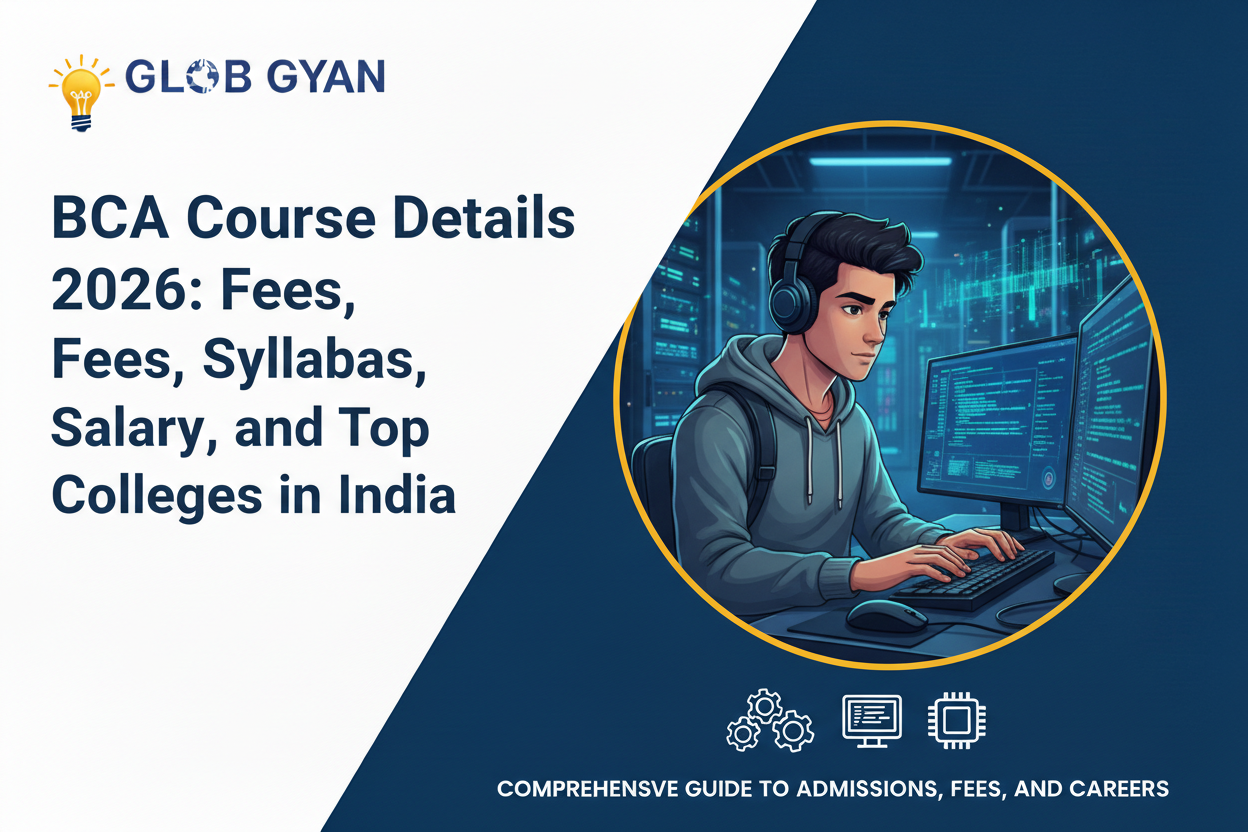
Thinking about a career in IT but confused if a BCA (Bachelor of Computer Applications) is the right move for you? You aren’t alone. In 2026, the Indian tech landscape has shifted. It’s no longer just about having a degree; it’s about having the right skills in AI, cloud, and data.
If you want to skip the 4-year heavy engineering maths of a B.Tech and dive straight into coding, software, and apps, BCA might be your golden ticket.
In this ultimate guide, we’ll break down everything—from BCA course details and subjects to the best colleges and the eye-popping salaries you can earn in 2026.
What is BCA? (Bachelor of Computer Applications)
BCA stands for Bachelor of Computer Applications. It is a 3-year undergraduate degree programme designed specifically for students who want to build a career in Information Technology (IT) and Software Development.
Think of it as the “practical cousin” of computer science engineering. While B.Tech focuses on how computers are built (hardware + software), BCA focuses on how to use computers to solve real-world problems through software, websites, and mobile apps.
Simple Definition: If you love coding, building websites, or creating the next viral app, BCA is the professional degree that teaches you how to do exactly that.
Why Choose BCA in 2026? (The Scope & Benefits)
The Indian IT sector is expected to hit a massive growth milestone by 2030. Here is why choosing BCA right now is a smart career move:
- Faster Entry into Tech: You become job-ready in 3 years instead of 4 (like B.Tech).
- Diverse Career Paths: You aren’t stuck in one role. You can become a web developer, data analyst, or even a cybersecurity expert.
- Focus on Modern Skills: Most 2026 BCA curricula now include Python, AI, and cloud computing from the first year.
- Cost-Effective: BCA is generally much more affordable than a B.Tech degree.
- Bridge to MCA: If you want “engineer-level” roles later, you can complete an MCA, which is globally recognised as equivalent to a B.Tech.
BCA Eligibility Criteria
To get admission into a BCA course in India, you generally need to meet these requirements:
- Educational Qualification: You must have passed 10+2 (12th Grade) from a recognised board (CBSE, ICSE, or State Boards).
- Minimum Marks: Most colleges require at least 45% to 55% aggregate in your 12th exams.
- Stream: Students from Science, Commerce, or Arts can apply! (Note: Some top-tier colleges still prefer students who had mathematics or computer science in the 12th).
- Age Limit: Usually between 17 and 25 years.
Step-by-Step BCA Admission Process
The admission process in India usually follows one of two paths:
Path A: Merit-Based Admission
Your 12th-grade board marks are your ticket. If your percentage is high (usually 85%+ for top colleges), you get direct admission.
Path B: Entrance-Based Admission
Many top universities conduct their own entrance exams.
- Register: Apply for the entrance exam (e.g., CUET, IPU-CET).
- Appear for Exam: Solve questions on basic math, English, logical reasoning, and computer awareness.
- Counselling: Based on your rank, you choose your college.
- Document Verification: Submit your 10th/12th mark sheets and pay the fees.
BCA Course Details: Duration, Subjects & Specializations
A standard BCA programme is divided into 6 semesters over 3 years.
BCA Degree Course Subjects (The Core Curriculum)
Here is what you will actually study:
| Year | Popular BCA Subjects |
| Year 1 | C Programming, Digital Electronics, Business Communication, Discrete Mathematics, Data Structures. |
| Year 2 | Java Programming, Operating Systems, Database Management (DBMS), Software Engineering, Computer Networks. |
| Year 3 | Python, web technologies (HTML/JS), cloud computing, AI basics, and a major industry project. |
Emerging Specializations (2026 Trends)
In 2026, many colleges offer “BCA (Hons)” with a focus on:
- Data Science: For those who love statistics and big data.
- Cyber Security: Focused on ethical hacking and network protection.
- AI & Machine Learning: The hottest field right now.
- Cloud Technology: Learning AWS, Azure, and Google Cloud.
Top BCA Colleges in India (2026 Rankings)
Choosing the right college can define your placement success. Here are the top performers:
Top Government Colleges (Low Fees)
- Banaras Hindu University (BHU), Varanasi
- Jamia Millia Islamia, Delhi
- GGSIPU (Indraprastha University), Delhi
- University of Mumbai
Top Private Colleges (Best Placements)
- Christ University, Bengaluru
- Symbiosis Institute (SICSR), Pune
- Loyola College, Chennai
- Amity University, Noida
- VIT, Vellore
BCA Fees Structure: Government vs Private
The cost of a BCA degree varies wildly depending on the institution.
| College Type | Average Annual Fees | Total 3-Year Cost |
| Government | ₹15,000 – ₹40,000 | ₹45,000 – ₹1.2 Lakhs |
| Private | ₹100,000 – ₹300,000 | ₹3 Lakhs – ₹9 Lakhs |
| Online/Distance | ₹12,000 – ₹30,000 | ₹36,000 – ₹90,000 |
Career Opportunities & Job Roles
What happens after you get that degree? The job market for BCA graduates is massive. You can work in MNCs like TCS, Infosys, Wipro, Google, and Amazon.
Common Job Roles:
- Software Developer: Creating and maintaining computer programs.
- Web Developer: Building front-end and back-end for websites.
- System Administrator: Managing a company’s IT network.
- Data Analyst: Interpreting data to help businesses make decisions.
- Mobile App Developer: Creating apps for Android and iOS.
- Technical Support Engineer: Solving tech-related issues for clients.
Salary Expectations in 2026
Salary depends on your skills, but here are the current market averages in India:
- Freshers (0-2 years): ₹3.5 LPA – ₹6 LPA
- Mid-Level (3-6 years): ₹8 LPA – ₹15 LPA
- Senior Roles (7+ years): ₹18 LPA – ₹40+ LPA
Pro Tip: In 2026, a BCA graduate with a certification in Cloud (AWS) or Full-stack Development earns roughly 30% more than a general BCA graduate.
Future Scope (2026–2035)
Is BCA future-proof? Yes.
As long as businesses use apps and the internet, they need BCA graduates. With the rise of AI-driven automation, the demand for people who can “manage the AI” is skyrocketing. BCA graduates who learn to code alongside AI tools (like GitHub Copilot) will be the most valuable assets in the coming decade.
BCA vs B.Tech (CSE): Which is Better?
This is the #1 question students ask. Let’s settle it:
| Feature | BCA | B.Tech (CSE) |
| Duration | 3 Years | 4 Years |
| Focus | Application & Software | Engineering & Hardware |
| Math Level | Moderate | High/Advanced |
| Cost | Budget-friendly | Expensive |
| Verdict | Best for quick entry into IT. | Best for deep core engineering. |
Who Should Choose BCA?
- You love computers but don’t want to study physics and chemistry for 4 years.
- You want to start working and earning as soon as possible.
- You have a creative mind for web design or app ideas.
- You come from a background but have a passion for tech.
Who Should Avoid It?
- If you are only doing it for the “degree” and have zero interest in coding.
- If you want to work in core hardware manufacturing (Intel, Nvidia), B.Tech is better there.
Realistic Challenges Students Face
- The “Skill Gap”: College syllabi can sometimes be outdated. You must learn extra skills (React, Node.js, AI) online.
- Initial Salary: Starting salaries at service companies (like TCS/Wipro) can be lower compared to product companies.
- Competition: Since anyone from any stream can join, the number of graduates is high. You need a strong portfolio to stand out.
Step-by-Step Career Roadmap After 12th
- Step 1: Complete 12th with at least 50% marks.
- Step 2: Research and apply for top BCA entrance exams (March–May).
- Step 3: During BCA, pick a niche (Web Dev, Data, or Cloud) and get certified.
- Step 4: Build at least 3-4 solid projects on GitHub.
- Step 5: Do an internship in your 5th semester.
- Step 6: Sit for campus placements or apply to startups via LinkedIn/Naukri.
Summary Table: BCA Quick Glance
| Particulars | Details |
| Full Form | Bachelor of Computer Applications |
| Duration | 3 Years (6 Semesters) |
| Average Fees | ₹50k – ₹5 Lakhs (Total) |
| Starting Salary | ₹3.5 – ₹6 LPA |
| Top Recruiters | TCS, Google, Infosys, Amazon, Accenture |
| Best City | Bangalore (Silicon Valley of India) |
Frequently Asked Questions (FAQ)
1. Are BCA course details in Hindi available?
Yes, many state universities in North India offer the course in the Hindi medium, but it is highly recommended to study in English, as the IT industry operates globally in English.
2. Can I do BCA without maths in 12th?
Yes! Many private universities, like Amity and LPU, and even some government colleges, allow students without maths to join, provided they pass a basic qualifying test.
3. What is the “BCA course kya hota h” simple answer?
BCA ek 3-saal ka degree course hai jismein aap computer software, programming languages (C++, Java, Python), aur web development seekhte hain taaki aap IT sector mein job kar sakein.
4. Is BCA better than B.Sc. IT?
BCA is more “application”-oriented (building apps), while B.Sc. IT is more “theory and concept”-oriented. For jobs in software companies, BCA is generally preferred.
5. Can I get a job at Google after BCA?
Yes, Google hires based on skills. If you are a top-tier coder with a strong LeetCode profile and projects, your degree matters less than your ability to solve problems.
6. What are the common BCA degree course subjects?
The main subjects are Programming in C, Java, Python, Database Management (SQL), Software Engineering, and Web Technology.
Final Career Advice
BCA is not just a degree; it’s a gateway. In the 2026 tech era, your degree gets you the interview, but your skills get you the job. Don’t just rely on your college books. Build things, break things, and keep learning.