


If you’ve ever wondered why Indians can quote Shakespeare but sometimes struggle with Sanskrit shlokas, the answer lies buried in history precisely in the British Education System in India.
Let’s take a simple journey through how education in India evolved under British rule from Gurukuls and Pathshalas to English-medium schools, exams, and certificates that still shape us today.
Before the British arrived, education in India had its own rhythm — spiritual, moral, and deeply rooted in local culture. The Indian education system during British rule, however, took a sharp turn.
The British didn’t just bring railways and tea; they also brought a new system of learning — one that emphasized English education, Western literature, and administrative training.
The goal? To create “a class of persons Indian in blood and colour, but English in taste.”
Yes, that famous line from Lord Macaulay’s Minute of 1835 pretty much sums it up!
1. Indian Education Before British Rule
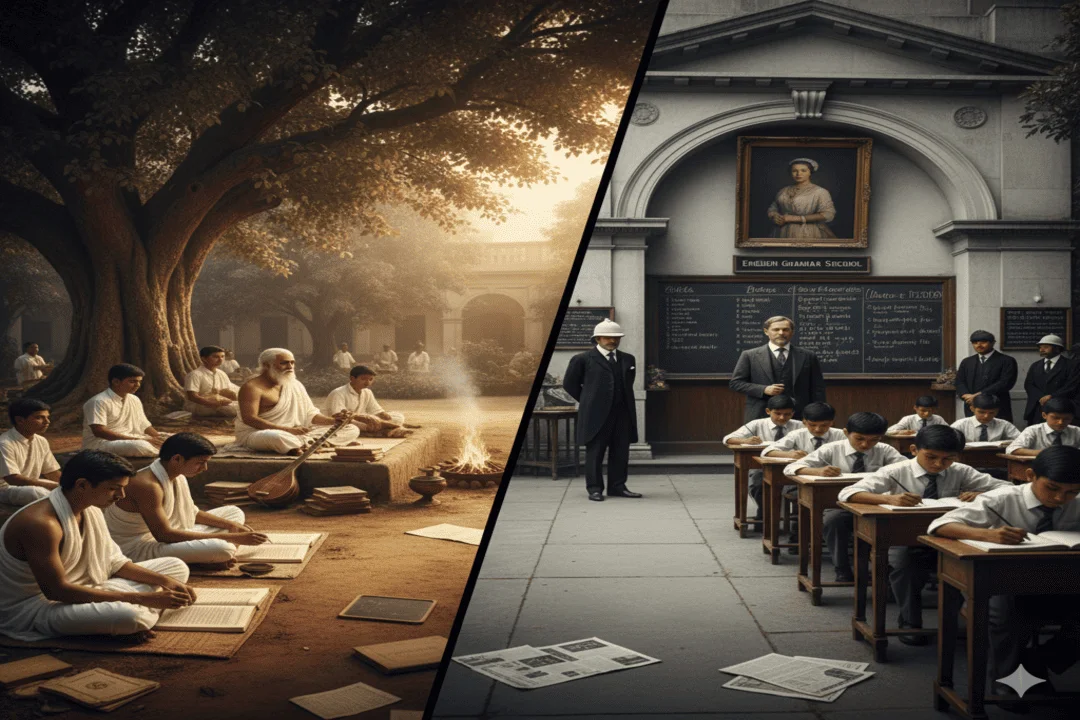
Long before the English alphabet entered the scene, India had Gurukuls, Madrasas, and Pathshalas centers of learning that focused on religion, philosophy, mathematics and moral values.
The history of education in India was vibrant and decentralized. Learning happened under trees, in temples, and mosques. But the system wasn’t perfect. It lacked uniformity, widespread access, and a structured curriculum.
Still, it was ours — an education deeply connected with culture and community.
2. Beginning of British Education Policy in India
When the British East India Company first set foot in India, education wasn’t really their priority. But soon, they realized that to rule effectively, they needed local helpers, people who could read, write, and follow orders in English.
This led to the Charter Act of 1813, which officially introduced the idea of educating Indians using company funds. However, there was a debate should education be Oriental (using Sanskrit and Persian) or Anglicist (using English)?
Guess who won?
The Anglicists. Thanks to Macaulay, English became the star subject, setting the stage for the development of education in British India.
3. Major Education Policies Under British Rule
a. Macaulay’s Minute (1835)
This was the turning point. Macaulay’s Minute 1835 declared English as the medium of instruction. The British now aimed to teach Indians Western science, philosophy, and literature.
His goal wasn’t to educate everyone but to create a small class of English-speaking Indians who could act as intermediaries. And well… it worked.
b. Wood’s Dispatch (1854)
Known as the “Magna Carta of English Education in India,” this dispatch was more organized. It recommended:
- Setting up a Department of Education
- Establishing universities in Calcutta, Bombay, and Madras
- Promoting women’s education
This was the first education policy in India and it laid the foundation for our modern university system.
c. Hunter Commission (1882–83)
This focused on primary and secondary education. It encouraged local bodies to manage schools — the beginning of decentralized education management.
d. Indian Universities Act (1904)
Passed under Lord Curzon, this Act tightened British control over universities. While it improved standards, it also limited academic freedom.
e. Sadler Commission (1917–19)
This report focused on higher education and recommended reforms for universities in India.
All these policies shaped what we now call the modern education system in India.
4. Features of the British Education System
The features of British education system in India were quite distinct:
- English Language Focus: English became the primary language of administration and higher education.
- Literary Over Technical Learning: More Shakespeare, less science.
- Clerical Training: The goal was not thinkers but clerks who could serve the Raj.
- Urban Bias: Rural areas were largely ignored.
So, while the system produced brilliant intellectuals, it also created an elite divide English-speaking Indians vs. the rest.
5. Objectives and Purpose
The objectives of British education policy in India were not as noble as they seemed. Let’s be honest — it wasn’t about enlightening India.
Their main goals were:
- Administrative Convenience: To get cheap, efficient clerks for British offices.
- Cultural Control: To spread Western values and reduce local traditions.
- Economic Gain: To create a market for British goods.
In short, the purpose of British education system was as much about control as it was about teaching.
6. Impact of British Education in India
Now, not everything was bad. Let’s give credit where due.
The impact of the British education system in India was both positive and negative.
Positive Effects:
- Growth of a new educated middle class
- Rise of nationalist leaders like Raja Ram Mohan Roy, Gandhi and Nehru who used English to communicate reform
- Introduction of modern subjects like science, math, and history
Negative Effects:
- Decline of traditional and vocational education
- Alienation from native culture
- Creation of social and linguistic divides
The effect of British education on Indian society was deep — it modernized India but also created dependency and inequality.
7. Comparison: Education Before and After British Rule
Let’s compare.
Before the British: learning in Sanskrit, Persian, and local languages; emphasis on spirituality and moral conduct.
After the British: learning in English, focus on literature, history, and clerical skills.
The Indian education before British rule was homegrown and value-based. Indian education after British rule became examination-based and bureaucratic.
8. Legacy of the British Education System
Despite its mixed intentions, the legacy of the British education system is undeniable.
We still follow an exam-heavy structure. We still celebrate university degrees as social status. And yes English remains the language of opportunity.
The father of modern education in India, Lord Macaulay (ironically, a British man), left behind a system that India later adapted and expanded.
But hey, let’s not forget this same system produced reformers, scientists, and writers who shaped modern India. The same English that once divided us now connects us globally.
So, perhaps the British gave us a system meant for control, but India turned it into a tool for empowerment.
9. Conclusion
The British education system in India was like that complicated dish — half-bitter, half-sweet. It dismantled traditional learning but introduced modern ideas. It divided society but also ignited a new wave of thinking.
From Macaulay’s Minute to Wood’s Dispatch, the British didn’t just change how Indians learned they changed how India thought.
Today, as we talk about education reforms, NEP 2020, and decolonizing our syllabus, we’re still writing the next chapter of a story that began in 1835.
And maybe, just maybe, it’s time to give equal love to both Shakespeare and Kalidasa!
Summary Table (Quick Revision for Students)
| Period | Policy / Act | Key Features |
| 1813 | Charter Act | Introduced British-funded education |
| 1835 | Macaulay’s Minute | English as medium; Western curriculum |
| 1854 | Wood’s Dispatch | University system, women’s education |
| 1882 | Hunter Commission | Primary & secondary focus |
| 1904 | Universities Act | Centralized control |
| 1917–19 | Sadler Commission | Higher education reforms |
FAQs
The British education system in India was a Western style model introduced by the British during colonial rule. It replaced the traditional Gurukul and Madrasa systems with English-based education focused on literature, science, and administrative training.
The system was mainly introduced by Lord Macaulay through his famous Macaulay’s Minute of 1835, which promoted English as the medium of instruction and Western-style education.
The main objective of British education policy in India was to create a class of educated Indians who could assist the British in administration. It also aimed to spread Western culture and reduce the influence of traditional Indian learning systems.
Key features of British education system in India included:
English as the primary language of instruction
Focus on literary rather than technical education
Centralized and exam-oriented learning
Creation of universities and formal degrees