




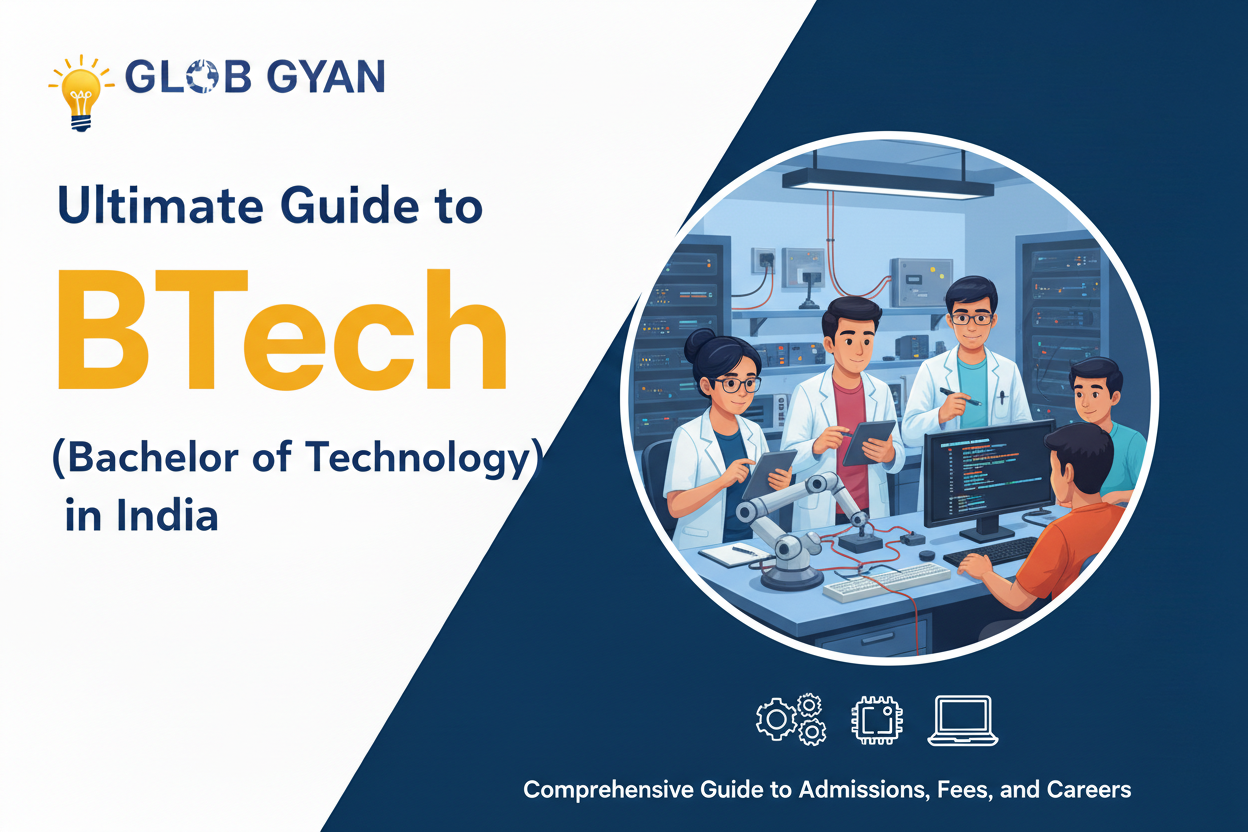
Are you standing at the crossroads after Class 12, wondering if a BTech is still the “golden ticket” to a successful career in 2026? With the rapid rise of AI, electric vehicles, and space tech, the landscape of engineering has shifted.
Choosing the right BTech course details can be the difference between a high-flying career at Google and struggling in a saturated job market. This guide is your ultimate roadmap to navigating the world of Bachelor of Technology in India, covering everything from the latest specialisations to 2026-specific salary trends.
What is BTech? (Definition & Simple Explanation)
BTech, short for Bachelor of Technology, is a professional undergraduate engineering degree awarded after four years of intensive study. Unlike a regular BSc, which is more theoretical, BTech is deeply rooted in practical application.
In simple terms, if a scientist discovers a law of physics, a BTech engineer uses that law to build a faster smartphone, a safer bridge, or a smarter AI bot. It is an industry-orientated course designed to make you “job-ready” by focusing on how technology solves real-world problems.
Why Choose BTech in 2026?
You might hear people say, “Everyone is doing engineering.” While true, the demand for skilled engineers has never been higher. Here’s why it remains a top choice:
- Recession-Proof Skills: Fields like cybersecurity and data science are critical to the global economy.
- High ROI (Return on Investment): A degree from a top-tier college can pay for itself within 2–3 years of working.
- Innovation Hub: India is now a global hub for SaaS, semiconductors, and startups. BTech graduates are the backbone of this growth.
- Global Mobility: An Indian BTech degree is highly respected in the US, Germany, and the Middle East for higher studies (MS) and jobs.
BTech Eligibility Criteria
Before diving into the course details, you must ensure you meet the basic requirements. For 2026, the criteria remain strict but offer some flexibility for new-age branches.
- Educational Qualification: You must pass Class 12 (Higher Secondary) from a recognised board (CBSE, ICSE, or State Boards).
- Core Subjects: Physics, Chemistry, and Mathematics (PCM) are mandatory.
- Minimum Marks: Most general category students need at least 60% aggregate in PCM. Top-tier institutes like IITs usually require 75%.
- Entrance Exams: Qualifying for a national or state-level entrance exam is almost always required.
Note: For B Tech biotechnology course details, some colleges allow Physics, Chemistry, and Biology (PCB).
Step-by-Step BTech Admission Process
The admission journey can be stressful, but following these steps makes it manageable:
- Step 1: Registration: Apply for entrance exams like JEE Main (usually in November-December).
- Step 2: Entrance Exams: Appear for the exams in January or April.
- Step 3: Result & Rank: Check your All India Rank (AIR).
- Step 4: Counselling (JoSAA/CSAB): Participate in the online choice-filling process where you select your preferred colleges and branches.
- Step 5: Document Verification: Submit your 10th/12th marksheet, category certificate, and admit card for physical or online verification.
- Step 6: Fee Payment: Pay the admission fee to freeze your seat.
BTech Course Details: Duration, Subjects, & Specializations
A standard BTech programme lasts 4 years, divided into 8 semesters.
The Semester Breakdown
- Year 1: Common for all branches (Applied Physics, Maths, Basic Programming, Engineering Graphics).
- Year 2: Introduction to core departmental subjects.
- Year 3: Advanced core subjects and elective choices.
- Year 4: Major project, industrial internship, and specialised electives.
Popular Specializations for 2026
While B Tech IT course details are always in demand, new-age branches are taking over:
| Specialization | Focus Area | 2026 Trend |
| Computer Science (CSE) | Coding, AI, Software | Extremely High Demand |
| Artificial Intelligence & ML | Neural Networks, Data Models | Fastest Growing |
| B Tech Biotechnology | Genetics, Healthcare Tech | High Growth (Post-Pandemic) |
| Information Technology (IT) | Networking, Database Management | Stable & High Paying |
| Mechanical Engineering | Robotics, EV, Manufacturing | Evolving with Automation |
| Civil Engineering | Smart Cities, Infrastructure | Steady Growth |
Top BTech Colleges in India (2026)
When looking for BTech course details, the college brand significantly impacts your first salary.
Government Institutes (The “Elite” Tier)
- IIT Madras, Delhi: the gold standard for engineering globally.
- NIT Trichy, Karnataka, Warangal: Excellent placements and lower fees.
- COEP Pune / Jadavpur University: Top-ranked state government colleges with legendary ROIs.
Private Universities (The “Infrastructure” Tier)
- BITS Pilani: Often considered at par with top IITs.
- VIT Vellore: Known for its massive campus and diverse specialisations.
- SRM Institute, Chennai: Great for B Tech IT course details and international collaborations.
- Manipal Institute of Technology (MIT): Offers excellent industry exposure.
Major BTech Entrance Exams
To get into the colleges mentioned above, you need to clear these hurdles:
- JEE Main: The gateway to NITs, IIITs, and GFTIs. Also the qualifier for JEE Advanced.
- JEE Advanced: The only way to enter the prestigious IITs.
- BITSAT: For admission into BITS Pilani, Goa, and Hyderabad.
- VITEEE: Dedicated exam for Vellore Institute of Technology.
- MHT CET / WBJEE / KCET: State-level exams for Maharashtra, West Bengal, and Karnataka, respectively.
BTech Fee Structure: Government vs Private
The cost of a BTech degree varies wildly based on the type of institution.
| Type of College | Annual Tuition Fee | Total 4-Year Cost |
| Government (IITs/N | ₹1.5 Lakh – ₹2.5 Lakh | ₹8 Lakh – ₹12 Lakh |
| State Government | ₹30,000 – ₹1 Lakh | ₹1.5 Lakh – ₹4.5 Lakh |
| Private Universities | ₹2.5 Lakh – ₹5 Lakh | ₹10 Lakh – ₹25 Lakh |
Note: Many government colleges offer fee waivers for students with family incomes below ₹1 lakh or ₹5 lakh per annum.
Career Opportunities & Job Roles
A BTech degree doesn’t just make you an “engineer”; it opens doors to various high-paying roles:
- Software Developer: Creating apps and systems (hiring volume).
- Data Scientist: Analysing “big data” to help businesses make decisions.
- AI/ML Engineer: Building smart systems and automation tools.
- Cybersecurity Analyst: Protecting companies from hackers (massive 2026 demand).
- Full Stack Developer: Managing both the front-end and back-end of websites.
- PSU Jobs: Working for Maharatnas like ONGC, BHEL, or GAIL via the GATE exam.
Salary Expectations (Entry to Senior Level)
Salaries in engineering are highly skill-dependent. In 2026, a fresher’s package can range from “decent” to “life-changing”.
- Tier 3 College Fresher: ₹3.5 LPA – ₹5 LPA
- Tier 1 College (IIT/NIT) Fresher: ₹12 LPA – ₹25 LPA
- Mid-Level (5–8 Years Exp): ₹15 LPA – ₹40 LPA
- Senior/Architect Level (10+ Years): ₹50 LPA – ₹1 Crore+
Future Scope: 2026–2035 Outlook
The next decade belongs to interdisciplinary engineering. We are moving away from “pure” branches.
- Mechanical engineers will need to know coding for robotics.
- Civil engineers will use AI for sustainable city planning.
- Biotech engineers will use data science for drug discovery.
The “full-stack engineer” of the future is someone who understands both the hardware and the software.
BTech vs. BE: What’s the Difference?
Many students get confused between BTech (Bachelor of Technology) and BE (Bachelor of Engineering).
- BTech: More application-based. The curriculum is updated frequently to match industry trends. Offered by IITs, NITs, and autonomous universities.
- BE: More theory-based. Focuses on the fundamental principles of engineering. Usually offered by traditional universities.
- Reality Check: In the job market, both are treated equally. Employers care more about your skills and college reputation than the name of the degree.
Who Should Choose BTech?
- You love solving puzzles and logical problems.
- You enjoy building things (digital or physical).
- You are comfortable with mathematics and physics.
- You have a “lifelong learner” mindset (tech changes every 6 months!).
Who Should Avoid It?
- You are choosing it only because of “parental pressure”.
- You have a strong dislike for mathematics.
- You prefer creative arts or pure theory over practical problem-solving.
- You expect a high-paying job without putting in the effort to learn skills outside the classroom.
Step-by-Step BTech Career Roadmap
After 10th
- Choose the science stream with mathematics (PCM).
- Start basic foundation coaching for JEE if aiming for top colleges.
During 12th
- Focus on board exams (need 75% for IITs).
- Apply for JEE Main, BITSAT, and State CETs.
After 12th
- Appear for exams and participate in counselling.
- Select a branch based on interest, not just “placements”.
During BTech (4 Years)
- Year 1: Maintain a high CGPA (above 8.0).
- Year 2: Learn a programming language (Python/C++) and do a mini-project.
- Year 3: Apply for internships. This is the most critical year.
- Year 4: Sit for campus placements or prepare for GATE/CAT/GRE.
Summary Table: BTech at a Glance
| Feature | Details |
| Full Form | Bachelor of Technology |
| Level | Undergraduate (Professional) |
| Duration | 4 Years |
| Eligibility | 10+2 with PCM (Minimum 50-75%) |
| Admission | Entrance Exam Based (JEE, BITSAT, VITEEE) |
| Avg. Fees | ₹1 Lakh to ₹4 Lakh per year |
| Starting Salary | ₹4 LPA to ₹15 LPA (Average) |
Frequently Asked Questions
1. What are the core BTech course details I should know?
A BTech is a 4-year technical degree focusing on the practical application of engineering. It covers 8 semesters, including a mandatory industrial internship and a final year project.
2. Is BTech better than BSc?
Yes, for students seeking technical job roles. BTech is a professional degree with higher industry value and better placement opportunities compared to a standard BSc.
3. Can I do BTech without JEE?
Yes. Many private universities (like BITS, VIT, and SRM) have their own exams. Many states also conduct their own CETs (MHT-CET, KCET) for local government and private colleges.
4. Which branch of BTech is best for the future?
Currently, Computer Science (CSE) within AI, Data Science, or Cybersecurity has the highest growth potential. However, Electronics (ECE) is also rising due to the semiconductor boom in India.
5. What are the B Tech biotechnology course details for PCB students?
Many universities allow PCB students to take biotechnology, provided they take a remedial mathematics course in their first year. It focuses on the intersection of biology and technology.
6. Can I get a government job after BTech?
Absolutely. You can join PSUs through the GATE exam or join the Indian Engineering Services (IES). You are also eligible for the UPSC Civil Services exam.
7. What is the average fee for BTech in India?
It ranges from ₹50,000 per year in state-aided colleges to ₹500,000 per year in top private universities.
8. Is there an age limit for BTech?
For JEE Main, there is no age limit, but you must have passed Class 12 in the last 3 years. Specific colleges may have their own age criteria.
Final Career Advice: Beyond the Degree
A BTech degree is a powerful tool, but in 2026, the paper alone isn’t enough. The industry doesn’t just hire “degree holders”; it hires problem solvers.
Don’t just stick to your college syllabus. Build a GitHub profile, contribute to open-source projects, and keep an eye on emerging trends like quantum computing and green energy. Whether you choose a core branch or IT, your curiosity will be your biggest asset.