


Have you ever imagined going to a school where there are no buzzing bells, no heavy backpacks, and no endless exams? Instead, you live with your teacher, help in daily chores, learn wisdom from ancient texts, and grow under the watchful care of a mentor. That’s what the Gurukul Education System was all about. Sounds like Hogwarts with less magic but more discipline, right?
In this article, let’s dive deep into the ancient Gurukul system, its history, structure, advantages and whether it still makes sense in today’s world of smart classrooms and online learning.
What is the Gurukul Education System?
The word “gurukul” comes from two Sanskrit words guru (teacher) and kula (family or home). Put simply, it was the ancient Indian education system where students, called shishyas, lived in the teacher’s home, studied, worked and grew together.
Unlike modern schools, which often focus on marks and degrees, the gurukul system of education emphasized holistic learning knowledge, discipline, values and life skills. Education wasn’t confined to books; it was about living, experiencing, and learning in harmony with nature.
A Journey Back: History of Gurukul in India
The ancient education system in India was deeply rooted in the vedic gurukul system. This system is as old as the Vedas themselves. Think about it: thousands of years ago, while the rest of the world was still figuring out farming, India had structured schools where philosophy, science, arts, and ethics were taught.
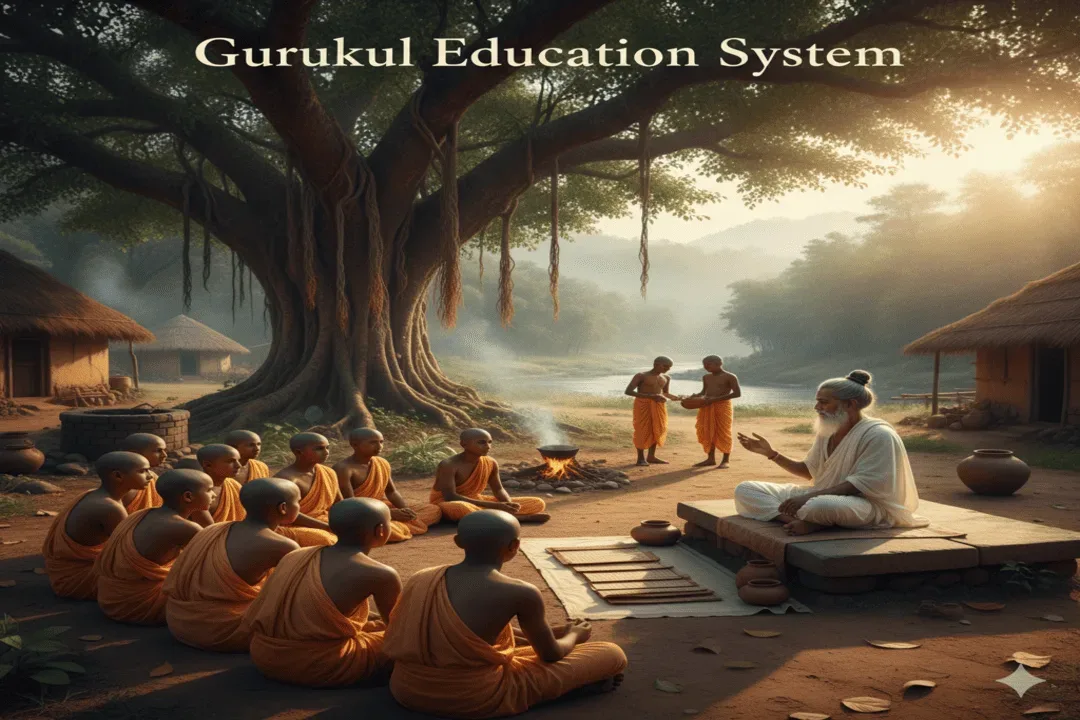
In an ancient Gurukul system, students would leave their homes as children and stay with their gurus until they were ready to face the world. The gurukul traditions weren’t just about learning hymns and scriptures. Students also practiced archery, medicine, astronomy, and even public speaking (yes, even in those times people had to give speeches!).
Some of the world’s greatest minds like Chanakya and Panini were products of the Indian gurukul education tradition. Sadly, with foreign invasions and colonial rule, the gurukul history saw decline, making way for a more Western model of schooling.
Inside the Walls of a Gurukul: Structure & Method
So, what exactly happened in a gurukul school?
Life in a gurukul lifestyle was simple, disciplined, and communal. Students woke up early (sorry late sleepers!), meditated, did chores like fetching water or collecting firewood and then studied under the guidance of their guru. The gurukul teaching method wasn’t about rote memorization. It was an experience students learned by doing. Want to understand farming? Work in the field. Want to learn discipline? Wake up at dawn every day.
The gurukul method emphasized values, responsibility, and self-reliance. The gurukul learning system encouraged practical knowledge, moral conduct, and respect for elders. And yes, the gurukul way of teaching made sure that no student was left behind since the guru personally mentored every disciple.
The Advantages of the Gurukul System
Now, let’s get to the fun part: why was this system so effective?
- Holistic Development – Unlike today’s schools that sometimes focus too much on exams, the advantages of the Gurukul system of education included developing mind, body, and spirit. Students learned yoga, meditation, arts and sciences side by side.
- Personalized Learning – In a gurukul model of education, the guru knew each student personally. Imagine your teacher not only teaching you but also knowing your strengths, weaknesses and character deeply.
- Practical Knowledge – The benefits of Gurukul system extended beyond academics. Students did chores, farming, cooking and community service. Life lessons were part of the syllabus.
- Discipline & Character Building – The gurukul traditions in India demanded punctuality, honesty, and respect. It wasn’t just about “scoring marks” but about becoming a responsible human being.
- Equality & Community Living – All students, whether from royal families or common homes, lived and learned together. The gurukul culture was built on cooperation and respect.
Gurukul vs Modern Education
Here comes the ultimate comparison: gurukul education vs modern education.
- Focus: Gurukul was about values and holistic growth; modern schools often emphasize exams and degrees.
- Method: The gurukul teaching system was experiential and personalized, while modern schools often follow a standardized approach.
- Lifestyle: In a modern gurukul, you may still find the old principles adapted to yoga sessions, meditation and life skills blended with math and science.
Of course, modern education has its perks, technology, global exposure and professional opportunities. But many educators argue that blending the gurukul model of education with today’s system could give us the best of both worlds.
Relevance in Today’s Times
Is the gurukul education in the modern era just a nostalgic fantasy, or does it have real-world relevance?
Actually, several gurukul schools in India are reviving this approach. They combine ancient wisdom with modern subjects. For example, a student might learn Sanskrit shlokas in the morning and coding in the afternoon. Pretty cool, right?
The Vedic education system in India still inspires many alternative schools today. Parents who value character-building, discipline and holistic development often explore the gurukul system of India as an option for their children. The truth is, in an age of stress and information overload, a gurukul lifestyle with its focus on simplicity, mindfulness and balance might be exactly what we need.
Conclusion
The Gurukul Education System is not just a chapter in history books, it’s a reminder that true education goes beyond marksheets and job titles. It’s about shaping a person’s mind, body, and soul to live with wisdom, discipline and compassion.
If today’s schools borrow even a little from the ancient Gurukul system like its focus on values, mindfulness and practical learning we’d see students who aren’t just chasing grades but are also ready for real life. After all, what’s the point of knowing algebra if you can’t handle stress, right?
Looking back, India’s educational journey has been rich and diverse. From the Buddhist Education System and great centers like Takshashila University history, to the Madrasa Education System, and later the British Education System in India, each phase added something unique. Yet, the gurukul traditions in India remain special because they were built on holistic growth rather than mechanical learning.
So maybe the future lies in blending the old with the new, a modern gurukul approach where technology meets timeless wisdom. Because at the end of the day, education should not just prepare us to earn a living, but also to live a meaningful, balanced, and happy life.
FAQs
The gurukul meaning is simple: a teacher’s home where students lived, studied and grew under guidance.
Everything from Vedas, philosophy, astronomy, and arts to archery and medicine. The gurukul history shows a diverse curriculum.
Yes! Several gurukul in India still function, blending modern academics with gurukul traditions.
Both have strengths. The gurukul vs modern debate isn’t about replacing one with the other but learning to combine the best of both.