




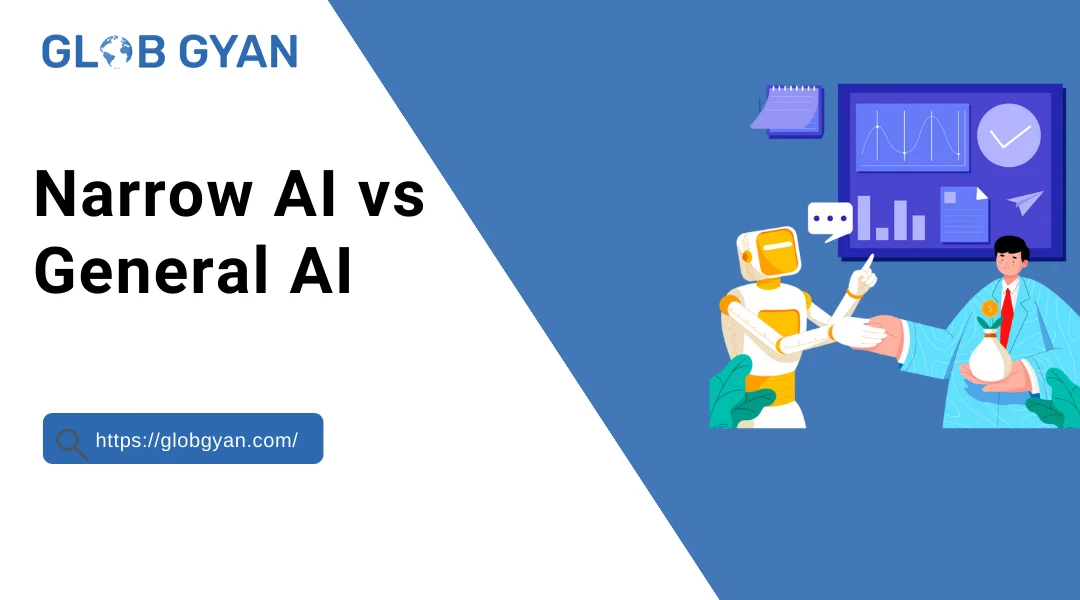
People talk about AI as if it’s one single thing. It’s not. Most confusion around artificial intelligence comes from mixing up two very different ideas Narrow AI vs General AI.
I used to think most AI systems were already “smart” in a human way. They’re not. Once you look closely at how they work, the gap becomes obvious. Understanding that gap changes how you look at modern technology.
What Is Narrow Artificial Intelligence?
Narrow Artificial Intelligence, also called narrow AI or weak artificial intelligence, is built to do one job well. That’s it. It doesn’t understand the world and it doesn’t think beyond what it’s trained for.
A narrow AI system can feel intelligent because it responds quickly and accurately. But that feeling disappears the moment it’s asked to do something outside its role. It doesn’t adapt like a human would, it just stops being useful.
Almost every AI system we use today fits into this category, whether people realize it or not.
Narrow AI Examples You Probably Use Every Day
The easiest way to understand this is through real Narrow AI examples.
Think about:
- voice assistants
- recommendation systems on YouTube or Netflix
- spam filters in email
- facial recognition on phones
- customer support chatbots
Each of these tools solves a narrow problem. A chatbot can answer predefined questions, but it can’t reason. A recommendation system can predict preferences, but it doesn’t understand taste.
That limitation is what defines narrow AI.
What Is General AI?
General AI, often called Artificial General Intelligence, is very different. It refers to a system that could understand, learn and apply intelligence across many unrelated tasks the way humans do.
A true general AI wouldn’t need to be retrained for every new situation. It would adapt, reason and learn broadly.
Right now, this kind of AI doesn’t exist. It’s discussed in research and theory, not used in real products.
Artificial General Intelligence vs Narrow AI
The comparison between artificial general intelligence vs narrow AI highlights the difference between today’s AI and human intelligence.
| Feature | Narrow AI | General AI |
| Task scope | Single-purpose | Multi-purpose |
| Learning | Limited to training data | Learns independently |
| Awareness | None | Human-like understanding |
| Availability | Common today | Theoretical |
| Example | Recommendation systems | Human intelligence |
This comparison explains why modern AI systems feel intelligent but still lack true understanding.
Types of Artificial Intelligence Explained
When people talk about the main Types of Artificial Intelligence, they’re usually referring to three categories.
1. Narrow AI (Weak Artificial Intelligence)
This is the AI we actually use today. It performs specific tasks efficiently.
2. General AI
A future concept where machines match human intelligence across tasks.
3. Super AI
A theoretical idea where AI surpasses human intelligence.
When people mention the common types of AI, they are almost always talking about narrow AI even if they don’t realize it.
Why Narrow AI Dominates Modern Technology
There’s a simple reason narrow AI dominates real systems: it’s predictable.
From a business point of view, predictability matters more than intelligence. Weak artificial intelligence can be tested, controlled, and improved without unexpected behavior. That’s why it’s trusted in healthcare, finance, marketing, and customer service.
General AI, if it ever exists, will come with far more uncertainty.
Artificial Intelligence and Automation
To really understand where AI fits today, you have to look at Artificial Intelligence and Automation together.
Automation repeats tasks. AI improves decisions inside those repeated processes. When combined, systems become efficient without pretending to be human.
This relationship is explained in more depth in the main pillar guide on Artificial Intelligence and Automation, where AI-driven workflows and automation are treated as parts of the same system. This is where AI stops sounding theoretical and starts feeling useful.
Will General AI Replace Narrow AI?
Even if general AI becomes possible one day, narrow AI won’t disappear. Specialized tools usually outperform general ones in focused tasks.
Humans specialize. Technology tends to follow the same pattern.
Why Understanding Narrow AI vs General AI Matters
Understanding Narrow AI vs General AI helps set realistic expectations. It reduces fear, cuts through hype and makes conversations about AI more grounded.
Not everything called “AI” is intelligent and that distinction matters more than most people think.
Final Thoughts
The debate around Narrow AI vs General AI isn’t about which one is better. It’s about understanding reality.
Narrow Artificial Intelligence powers most tools we rely on today. General AI remains a long-term research idea. Once you see that clearly, artificial intelligence becomes less mysterious and much easier to judge realistically.
FAQs
Narrow AI is an artificial intelligence system designed to perform a specific task within defined limits.
Yes. Narrow AI and weak artificial intelligence refer to the same concept.
Voice assistants, recommendation engines, spam filters and chatbots are common examples.
Narrow AI focuses on one task, while general AI would have human-like intelligence across tasks.
No. General AI is still theoretical and under research.