


Choosing a career in healthcare is a noble pursuit, but the road doesn’t always have to lead to a general hospital ward. For many students, the dream is to combine medical science with artistic precision, flexible working hours, and the joy of seeing a patient leave with a renewed smile.
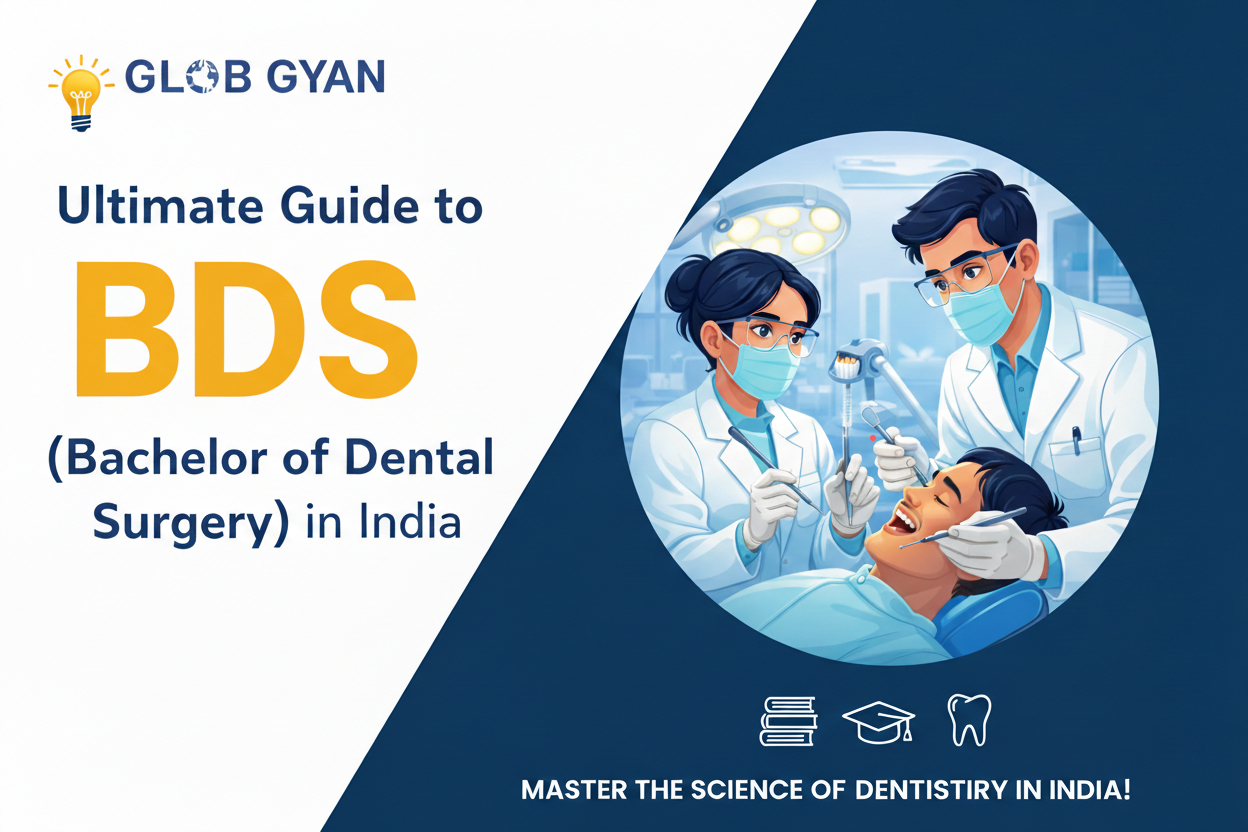
If you are a student standing at the crossroads of your 10+2 journey, wondering if you should pursue a career in oral health, you are in the right place. The full form of BDS is Bachelor of Dental Surgery, and it is the only professional dental degree recognized in India. While often considered the “second choice” after MBBS, BDS IN INDIA has evolved into a powerhouse of opportunity, offering a unique blend of entrepreneurship, specialized surgery, and a lifestyle that many medical professionals envy.
This guide will walk you through everything from the full form of BDS to the admission process for 2026, salary expectations, and the reality of the profession today.
Key Takeaways Summary
- Full Form: Bachelor of Dental Surgery.
- Duration: 5 Years (4 years academic + 1-year mandatory internship).
- Eligibility: 10+2 with PCB (Physics, Chemistry, Biology) and a mandatory NEET-UG qualification.
- Core Focus: Diagnosis, prevention, and treatment of oral diseases and dental surgeries.
- Top Career Paths: Private practice, MDS (Specialization), Army Dental Corps, and Healthcare Management.
What is BDS? (Clear Explanation)
The full form of BDS is Bachelor of Dental Surgery. It is a 5-year undergraduate professional degree program for those who want to become licensed dentists. In India, the course is regulated by the Dental Council of India (DCI).
Unlike a general physician, a BDS graduate is a specialist from day one. You aren’t just looking at “teeth”; you are studying the entire craniofacial complex, which includes the jaw, oral cavity, and associated structures. By the end of the course, you earn the title of “Doctor” (Dr.) and the legal right to perform dental surgeries.
Why It Matters: The Benefits of BDS IN INDIA
Why should you choose BDS IN INDIA over other medical paths?
- Work-Life Balance: Unlike general surgeons who might face midnight emergencies, dentists usually work on an appointment-based system.
- Entrepreneurial Freedom: It is much easier and more affordable to open a private dental clinic than a full-scale multi-specialty hospital.
- High Demand: With the rise of “Cosmetic Dentistry” and “Smile Makeovers,” people are spending more than ever on dental aesthetics.
- Job Security: Dental issues cannot be treated by AI or teleconsultation alone. Hands-on manual dexterity is a must, making your skills future-proof.
Key Specialties in BDS
While the undergraduate degree is general, it introduces you to several fascinating branches that you can later specialize in via an MDS (Master of Dental Surgery):
- Orthodontics: Fixing “crooked” teeth with braces and aligners.
- Oral & Maxillofacial Surgery: Performing complex surgeries on the jaw and face.
- Endodontics: The world of Root Canal Treatments (RCT).
- Pedodontics: Specialized dental care for children.
- Prosthodontics: Dealing with dentures, implants, and bridges.
The Step-by-Step Process to Get Admission in 2026
Step 1: Eligibility Check
To apply for BDS IN INDIA, you must have:
- Completed 10+2 with at least 50% marks in Physics, Chemistry, and Biology (40% for reserved categories).
- Reached the age of 17 years by December 31st of the admission year.
Step 2: Crack the NEET-UG Exam
Admission to every single dental college in India—whether government or private—is based on the NEET (National Eligibility cum Entrance Test). For 2026, the exam is expected to be held in the first week of May.
Step 3: The Counseling Process
After the results, you must participate in:
- MCC Counseling: For 15% All India Quota (AIQ) seats in government colleges and 100% seats in Deemed Universities.
- State Counseling: For the 85% state quota seats in your respective home state.
BDS Syllabus: What Will You Study?
The curriculum is a mix of general medicine and dental-specific subjects.
- Year 1 & 2: Human Anatomy, Physiology, Biochemistry, and Dental Materials.
- Year 3: General Medicine, General Surgery, and Oral Pathology.
- Year 4: Focus on clinical subjects like Oral Surgery, Periodontics, and Conservative Dentistry.
- Year 5 (Internship): Hands-on rotation where you treat actual patients under supervision.
Advantages & Disadvantages of a BDS Career
| Advantages | Disadvantages |
| Early financial independence (5 years vs 5.5+ for MBBS). | Initial cost of setting up a private clinic can be high. |
| Opportunity for creative, hands-on surgical work. | Physical strain (back and neck issues) from long sitting hours. |
| No night shifts or grueling emergency duties. | Higher competition in urban metropolitan areas. |
| Global opportunities in the Gulf, USA, and UK. | Government job vacancies are fewer than MBBS. |
Cost of BDS IN INDIA
The fee structure varies drastically depending on the type of institution:
- Government Colleges: ₹15,000 to ₹1,00,000 per year.
- Private Colleges: ₹3,00,000 to ₹8,00,000 per year.
- Deemed Universities: ₹10,00,000 to ₹25,00,000 for the full course.
Salary Expectations 2026
- Freshers (Private Clinic): ₹15,000 – ₹25,000 per month.
- Government Medical Officer: ₹60,000 – ₹90,000 per month.
- Army Dental Corps: ₹80,000+ per month.
- Established Private Practice: ₹1,00,000 to ₹5,00,000+ per month (Sky is the limit).
Comparison: BDS vs. MBBS
Many students ask: “Is BDS better than MBBS?”
- Duration: BDS is 5 years; MBBS is 5.5 years.
- Difficulty: MBBS has a broader syllabus; BDS is more specialized and requires higher manual skills.
- Stress: BDS offers a much better work-life balance.
- Career: MBBS has more government job openings; BDS is better for starting your own business early.
Common Mistakes to Avoid
- Ignoring NEET Prep: Don’t think BDS is “easy to get.” The cut-offs for top government dental colleges like Maulana Azad (MIDS) are very high.
- Choosing College Based Only on Fees: Check the “Patient Inflow.” If a college has no patients, you won’t learn how to extract a tooth or perform a filling.
- Stopping at BDS: In today’s market, doing a fellowship or an MDS is crucial to stand out from the crowd.
Future Trends in Dentistry
- Digital Dentistry: 3D printing of teeth and AI-driven diagnosis are the next big things.
- Medical Tourism: Patients from the West are flocking to India for affordable dental implants.
- Teledentistry: Consultations for braces and follow-ups are moving online.
Expert Tips for Aspirants
“Focus on your hand-eye coordination. Dentistry is as much an art as it is a science. If you enjoy working with your hands and have patience, you will thrive.” — Dr. Sharma, Senior Consultant.
- Stay Updated: Follow the Dental Council of India (DCI) website for the latest 2026 regulations.
- Master Communication: A dentist’s success depends 50% on skill and 50% on how they talk to patients.
BDS Action Checklist:
- Verify 10+2 PCB marks (Min 50%).
- Register for NEET-UG 2026.
- Research Top 10 Dental Colleges in your state.
- Prepare documents (Caste certificate, Marksheets, ID proof
Top 10 Dental Colleges in India ( Rankings)
The following colleges are ranked based on the National Institutional Ranking Framework (NIRF) and are considered the gold standard for BDS IN INDIA.
| NIRF Rank | College Name | Location | Type | Est. Annual Fees |
| 1 | AIIMS (All India Institute of Medical Sciences) | New Delhi | Government | ₹1,628 |
| 2 | Saveetha Institute of Medical & Technical Sciences | Chennai | Private | ₹8,00,000+ |
| 3 | Maulana Azad Institute of Dental Sciences (MAIDS) | New Delhi | Government | ₹4,120 |
| 4 | Dr. D. Y. Patil Vidyapeeth | Pune | Private | ₹6,00,000+ |
| 5 | Manipal College of Dental Sciences (MCODS) | Manipal | Private | ₹7,00,000+ |
| 6 | A.B. Shetty Memorial Institute of Dental Sciences | Mangaluru | Private | ₹4,00,000+ |
| 7 | King George’s Medical University (KGMU) | Lucknow | Government | ₹54,900 |
| 8 | SRM Dental College | Chennai | Private | ₹5,00,000+ |
| 9 | Siksha ‘O’ Anusandhan (SOA) | Bhubaneswar | Private | ₹5,50,000+ |
| 10 | JSS Dental College and Hospital | Mysuru | Private | ₹4,50,000+ |
Expected NEET 2026 Cutoffs for Top Government Colleges
To get into a premier government institution for Bachelor of Dental Surgery, students should aim for the following score ranges (out of 720).
| College Name | General (UR) | OBC Category | SC Category | ST Category |
| MAIDS, New Delhi | 650 – 670 | 630 – 645 | 550 – 570 | 520 – 540 |
| KGMU, Lucknow | 620 – 640 | 600 – 615 | 510 – 530 | 480 – 500 |
| GDC, Mumbai | 610 – 630 | 590 – 610 | 500 – 520 | 470 – 490 |
| GDC, Bangalore | 600 – 620 | 580 – 600 | 490 – 510 | 460 – 480 |
| IMS-BHU, Varanasi | 630 – 650 | 610 – 625 | 520 – 540 | 490 – 510 |
Note: These are estimated “safe scores” for 2026 based on 2025 trends. Actual cutoffs fluctuate based on paper difficulty and the total number of applicants.
- Do I get a “Dr” prefix after BDS?
Yes, you are a legally recognized Doctor. - What is the difference between a Dentist and an Orthodontist?
A Dentist has a BDS; an Orthodontist has an MDS specialization in tooth alignment. - Is BDS a good career for the future?
Yes, especially with the growing focus on cosmetic surgery and oral hygiene.
Final Actionable Conclusion
BDS IN INDIA is a rewarding, stable, and prestigious career choice. If you have a passion for healthcare but want the freedom of being your own boss, the full form of BDS—Bachelor of Dental Surgery—is the degree for you. Start your NEET 2026 preparation today, focus on Biology, and keep an eye on the counseling dates!
(FAQs)
- What is the full form of BDS?
It stands for Bachelor of Dental Surgery. - Is NEET compulsory for BDS in India?
Yes, NEET is mandatory for admission to all dental colleges in India. - Can I practice medicine after BDS?
No, you can only practice dentistry and perform oral surgeries. - How many years is the BDS course?
It is a 5-year course, including 4 years of study and 1 year of internship. - What is the salary of a BDS doctor in India?
Freshers start at ₹2–4 LPA, but experts in private practice can earn ₹12–20 LPA or more. - Is BDS better than MBBS?
It depends on your interest. If you want a better work-life balance and early practice, BDS is excellent. - Can I do an MBA after BDS?
Yes, many students pursue an MBA in Healthcare Management or Hospital Administration. - What is MDS?
MDS is Master of Dental Surgery, the postgraduate specialization after BDS. - Are there government jobs after BDS?
Yes, in government hospitals, Railways, and the Armed Forces (Army Dental Corps). - Is there a lot of blood in BDS?
Yes, as a surgeon, you will deal with extractions and surgeries involving blood. - Can I go abroad after BDS?
Yes, but you usually need to clear licensing exams like the NDEB (Canada) or INBDE (USA). - Is BDS very difficult?
It is academically rigorous and requires significant practical/manual skill. - What is the age limit for BDS?
Minimum 17 years; there is currently no upper age limit for NEET. - Which is the best college for BDS in India?
Maulana Azad Institute of Dental Sciences (Delhi) and Manipal College of Dental Sciences are top-ranked. - What subjects are in the 1st year of BDS?
Anatomy, Physiology, Biochemistry, and Dental Anatomy. - Is a laptop required for BDS?
Not mandatory, but helpful for digital records and studying. - Can I open my own clinic immediately after BDS?
Yes, once you are registered with the State Dental Council.