




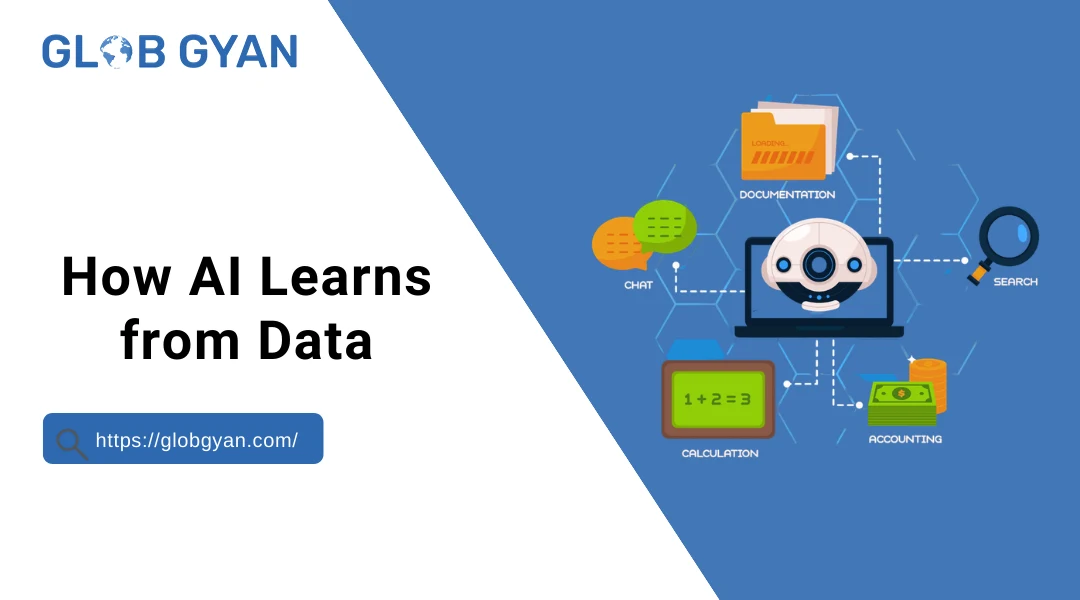
Artificial intelligence has quietly become part of our daily routine. From personalized shopping recommendations to smart voice assistants and automated customer service, AI systems are working behind the scenes to make technology smarter. But many people still wonder how AI learns from data?
Unlike humans, machines do not learn through emotions or personal experiences. Instead, they rely on structured information and repeated practice. The more data they receive the better they become at recognizing patterns and making decisions. Understanding how artificial intelligence learns is essential for anyone exploring modern technology or the growing world of artificial intelligence and automation.
Let’s break down the AI learning process in a simple and practical way.
What Does It Mean When AI Lears from Data?
At its core, AI learning means recognizing patterns inside large datasets. Humans learn by observation and repetition and similarly, AI systems improve performance through exposure to examples.
When people ask how machines learn from data, the answer lies in algorithms. These algorithms analyze information repeatedly until they detect meaningful relationships.
For example:
- Email spam filters learn by analyzing thousands of emails.
- Streaming platforms study viewing habits to recommend movies.
- Online stores analyze purchases to suggest products.
This approach is called data-driven AI learning, where decisions are based on data rather than manual programming.
The AI Training Process Step by Step
The journey of how AI systems learn usually follows a structured workflow. Every stage contributes to turning raw information into useful intelligence.
Collecting Training Data
Everything begins with training data in AI. This data acts as the learning material for machines.
It may include:
- Images and videos
- Written text
- Customer behavior records
- Audio samples
High-quality datasets are essential because AI reflects the information it receives.
Preparing Data for Machine Learning
Raw data often contains errors or missing values. Before training starts, engineers clean and organize datasets.
This preparation stage is critical for successful machine learning data training, because even advanced models cannot perform well with poor data quality.
Model Training and Pattern Recognition
During the main AI training process, algorithms analyze data repeatedly.
This is where how machines learn from data becomes visible. Models compare predictions with expected outcomes and adjust themselves automatically.
Complex systems use the neural networks learning process, which mimics how neurons in the human brain process information.
Testing and Improvement
After training, models are tested using new datasets.
If the system performs well, it moves into real-world applications. Otherwise, engineers retrain or adjust it.
Many AI solutions continue improving even after deployment, especially in recommendation engines or chatbots that learn from user interaction.
Artificial Intelligence Learning Methods
Different problems require different learning strategies. These approaches are known as artificial intelligence learning methods, and they help AI adapt to various industries.
Supervised Learning: Learning with Guidance
One of the most widely used techniques is supervised learning.
Here, AI learns from labeled datasets where correct answers already exist.
Examples include:
- Medical image diagnosis.
- Fraud detection systems.
- Speech recognition software.
Because the system receives clear feedback, supervised learning produces reliable results for prediction tasks.
Unsupervised Learning: Discovering Patterns Independently
In unsupervised learning, machines receive data without labels.
Instead of being told what to look for, AI explores datasets to discover patterns on its own.
Businesses use this method for:
- Customer segmentation.
- Market trend analysis.
- Detecting unusual activities in cybersecurity.
Unsupervised learning is especially useful when dealing with massive datasets that humans cannot easily categorize.
Reinforcement Learning: Learning Through Experience
Another important approach is reinforcement learning.
In this method, AI improves through rewards and penalties.
Imagine teaching a robot to perform a task:
- Successful actions earn rewards.
- Mistakes reduce performance scores.
Over time, the system identifies the best strategy.Reinforcement learning powers robotics, gaming AI and autonomous driving technologies.
Machine Learning Algorithms Behind AI Learning
The real intelligence behind AI comes from machine learning algorithms.
These mathematical models process data and adjust themselves during training.
Popular algorithms include:
- Decision Trees
- Support Vector Machines
- Neural Networks
- Regression Models
Each algorithm serves different purposes depending on the complexity of the task.
When businesses implement automation tools, selecting the right algorithm becomes essential for efficiency and accuracy.
Neural Networks and Deep Learning Training
Modern AI breakthroughs largely come from deep learning.
The neural networks learning process uses layers of artificial neurons to analyze information step by step.
During deep learning training, data moves through:
- Input layers that receive information.
- Hidden layers that detect complex patterns.
- Output layers that generate predictions.
This method powers technologies such as:
- Image recognition.
- Language translation.
- Voice assistants.
Deep learning has significantly accelerated progress in automation and intelligent decision-making.
How AI Systems Learn Continuously
Many people assume training happens only once, but that is not true.
Modern systems constantly evolve.
Understanding how AI systems learn over time means recognizing feedback loops. When users interact with AI tools, new data is generated.
For example:
- Streaming platforms adjust recommendations based on viewing history.
- Navigation apps learn from traffic updates.
Continuous learning helps systems remain accurate in changing environments.
How AI Systems Learn Over Time
Many people wonder how AI systems learn continuously.
The answer lies in feedback loops.
After deployment, AI models collect new data from real-world usage.
Examples include:
- Recommendation engines learning from clicks.
- Navigation apps improve routes based on traffic patterns.
This continuous learning improves accuracy and user experience. However, human monitoring remains important to prevent bias or unexpected outcomes.
The Role of Training Data in AI Success
No AI system can succeed without quality data.
Training datasets influence:
- Accuracy
- Fairness
- Performance.
If biased or incomplete information is used, AI may produce incorrect predictions.
That is why companies invest heavily in collecting reliable datasets for machine learning data training.
Data privacy and ethical sourcing are also becoming critical concerns in modern AI development.
Challenges in Learning in Artificial Intelligence
Despite its advantages, learning in artificial intelligence comes with challenges.
Some common issues include:
- High computing costs.
- Data privacy concerns.
- Algorithm bias.
- Large energy consumption during deep learning training.
Organizations must balance innovation with responsible AI practices.
Artificial Intelligence and Automation Working Together
AI learning directly supports automation across industries.
Businesses use intelligent systems to automate repetitive or complex tasks such as:
- Customer support responses.
- Inventory forecasting.
- Fraud detection.
When AI learns from operational data, automation becomes adaptive rather than rigid.
This combination of intelligence and efficiency explains why artificial intelligence and automation are transforming healthcare, finance, retail and manufacturing.
The Future of Data-Driven AI Learning
As technology advances, the way machines learn continues to evolve.
Researchers are developing systems capable of learning faster with smaller datasets. Personalized healthcare, smart cities and autonomous transportation are already benefiting from improved AI learning models.
Understanding how artificial intelligence learns is no longer limited to engineers. It is becoming essential knowledge for businesses and individuals navigating a digital future.
Conclusion
Learning is what makes artificial intelligence powerful. From supervised learning and unsupervised learning to reinforcement learning and deep neural networks, AI depends on structured training and continuous improvement. As data continues growing worldwide, the connection between learning systems and automation will become even stronger. Knowing how AI learns from data helps us better understand the technology shaping tomorrow’s world.
FAQs
AI learns by analyzing large datasets using machine learning algorithms. These algorithms identify patterns, compare predictions with outcomes and improve accuracy over time.
Training data is structured information used to teach AI systems. It can include images, text, audio or user behavior data that helps models recognize patterns.
Data determines how accurate and reliable an AI system will be. Poor or biased data can lead to incorrect predictions and unfair outcomes.
Machine learning uses algorithms to learn from data, while deep learning uses neural networks with multiple layers to analyze complex patterns.
Yes, many modern AI systems improve continuously by collecting new data and adjusting their models based on user interactions.