




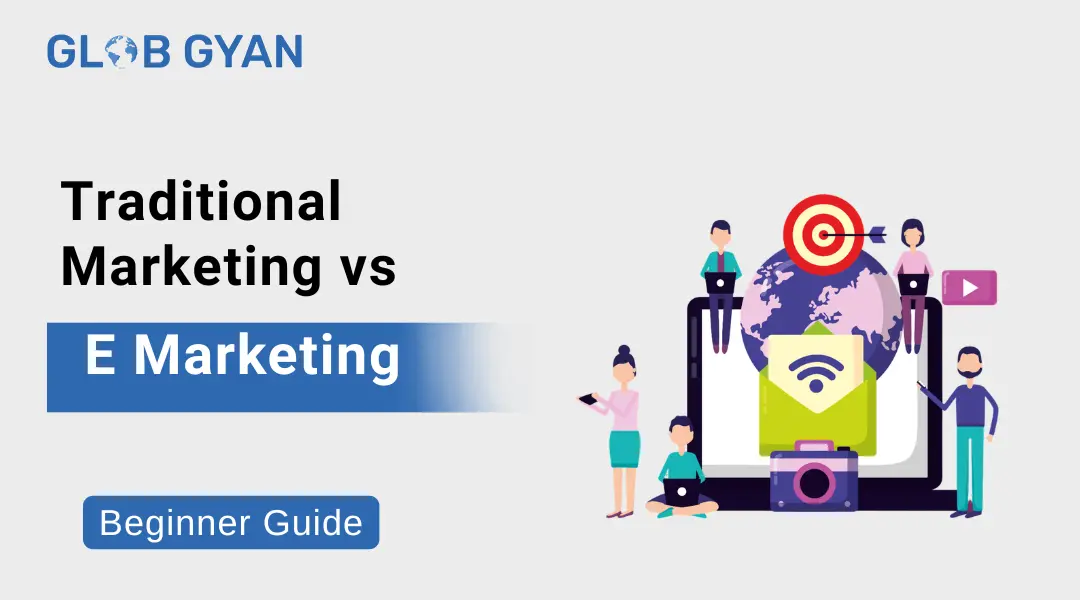
Marketing plays a crucial role in the success of any business because it helps companies connect with their target audience, promote products, and increase sales. Over the years, marketing has evolved significantly with the advancement of technology and the internet. Earlier, businesses relied heavily on traditional methods such as newspapers, television, radio, and billboards to reach customers. However, with the rise of digital platforms, e marketing has become a powerful and effective way to promote products and services globally.
In today’s competitive business environment, companies must understand the differences between traditional and digital marketing to choose the right strategy. While traditional marketing focuses on offline promotion and mass communication, e marketing uses online platforms and data-driven strategies to target specific audiences. Both marketing methods have their own advantages and limitations, and businesses often use a combination of both to achieve better results. This article provides a detailed and updated comparison of traditional marketing vs e marketing to help businesses and students understand which approach works best in 2026.
What is Traditional Marketing?
Traditional marketing refers to the use of offline marketing channels to promote products and services to a broad audience. It is one of the oldest forms of marketing and has been used by businesses for many decades. Traditional marketing focuses on reaching a large number of people through physical and broadcast media, making it effective for brand awareness and local promotion.
This type of marketing does not rely on the internet and is mainly used through print media, television, radio, and outdoor advertising. Many large companies still use traditional marketing because it builds trust and credibility among customers. It is especially useful for businesses targeting local audiences or older generations who prefer offline communication.
Examples of Traditional Marketing:
- Television advertisements
- Newspaper and magazine ads
- Radio commercials
- Billboards and hoardings
- Flyers and brochures
- Event marketing and banners
Traditional marketing is simple to understand and helps businesses create a strong brand presence in the market. However, it usually requires a high budget and does not provide accurate performance tracking like digital marketing.
What is E Marketing?
E marketing, also known as digital marketing or internet marketing, refers to the promotion of products and services using online platforms and internet-based technologies. It is a modern marketing approach that allows businesses to reach a global audience in a cost-effective and measurable way. E marketing focuses on targeted advertising, customer engagement, and real-time performance tracking.
With the increasing use of smartphones, social media, and search engines, e marketing has become an essential tool for businesses. Companies can promote their products through websites, social media platforms, search engines, and email campaigns. This method helps businesses connect directly with customers and build long-term relationships.
Examples of E Marketing:
- Search Engine Optimization (SEO)
- Social Media Marketing
- Email Marketing
- Content Marketing
- Google Ads and PPC advertising
- Influencer Marketing
The major advantage of e marketing is that businesses can track performance, analyze customer behavior, and optimize campaigns easily. This makes it an important part of the difference between traditional marketing and e marketing in modern business strategies.
Traditional Marketing vs E Marketing
Understanding the difference between traditional and e marketing helps businesses choose the most effective marketing strategy. Both methods aim to promote products and increase sales, but they differ in reach, cost, communication, and performance tracking.
| Basis | Traditional Marketing | E Marketing |
| Reach | Local or regional audience | Global audience |
| Cost | Expensive | Cost-effective |
| Communication | One-way communication | Two-way communication |
| Tracking | Difficult to measure | Real-time analytics |
| Flexibility | Limited changes | Easy to modify campaigns |
| Engagement | Low interaction | High engagement |
| Speed | Slow results | Fast results |
| ROI | Hard to measure | Easy to measure |
In the debate of traditional marketing vs e marketing, digital marketing clearly provides better targeting and measurable results. However, traditional marketing is still valuable for brand credibility and mass promotion. Businesses today often combine both strategies to maximize their reach and effectiveness.
Advantages of Traditional Marketing
Traditional marketing offers several benefits, especially for businesses that want to build brand awareness in local markets. One of the biggest advantages is trust and credibility. People often trust television advertisements, newspaper ads, and billboards because they are familiar and widely recognized forms of advertising.
Another advantage is high visibility. Billboards and TV ads reach a large audience quickly, making them useful for product launches and brand promotion. Traditional marketing is also easy to understand because it does not require technical knowledge or digital skills.
It is especially effective for targeting older audiences who may not use social media or online platforms frequently. Local businesses such as restaurants, schools, and retail shops often use traditional marketing to attract nearby customers. Even though it is expensive, traditional marketing helps create a strong brand image and long-term market presence.
Advantages of E Marketing
E marketing has become the most popular marketing method because of its cost-effectiveness and global reach. One of the biggest advantages is that businesses can reach customers worldwide through online platforms. Small businesses and startups can promote their products without spending large amounts of money.
Another major benefit is targeted advertising. Companies can select their audience based on age, location, interests, and behavior, which increases the chances of conversion. E marketing also provides real-time analytics, allowing businesses to track performance and improve their campaigns instantly.
Customer engagement is another important advantage. Social media platforms allow businesses to interact with customers, respond to queries, and build relationships. Automation and artificial intelligence also make marketing more efficient by personalizing content and improving customer experience.
Because of these benefits, many companies prefer e marketing over traditional marketing in the comparison of traditional marketing vs e marketing.
Disadvantages of Traditional Marketing
Traditional marketing also has some limitations that make it less effective in modern times. One major disadvantage is high cost. Television ads, newspaper advertisements, and billboards require a large budget, which is not affordable for small businesses.
Another disadvantage is the lack of performance tracking. Businesses cannot measure how many people saw the advertisement or how many customers were influenced by it. This makes it difficult to calculate return on investment.
Traditional marketing also offers limited audience targeting, which means advertisements are shown to a broad audience instead of specific customers. As a result, businesses may not get the desired results from their campaigns.
Disadvantages of E Marketing
Despite its advantages, e marketing also has some challenges. One major issue is internet dependency. Without internet access, businesses cannot run online campaigns or reach customers.
Another disadvantage is high competition. Many companies are using digital marketing, which makes it difficult to stand out in the market. Businesses also need technical skills and knowledge to manage SEO, social media, and online advertisements effectively.
Security and privacy concerns are also important issues in e marketing. Data breaches and cyber threats can affect customer trust and brand reputation. However, with proper strategies and tools, these challenges can be managed successfully.
Traditional Marketing vs E Marketing – Which is Better in 2026?
The choice between traditional marketing and e marketing depends on business goals, target audience, and budget. Large companies often use traditional marketing for brand awareness, while startups and small businesses prefer e marketing because it is affordable and measurable.
In 2026, most businesses are adopting a hybrid marketing approach that combines both traditional and digital methods. For example, a company may use television ads for brand promotion and social media marketing for customer engagement. This combination helps businesses reach both offline and online audiences effectively.
Therefore, in the comparison of traditional marketing vs e marketing, neither method is completely better than the other. The best approach is to use both strategies together to achieve maximum results.
Future of Traditional Marketing and E Marketing
The future of marketing is becoming more digital and technology-driven. Artificial intelligence, automation, and data analytics are transforming the way businesses promote their products. E marketing is expected to grow rapidly as more people use smartphones and online platforms.
However, traditional marketing will not disappear completely. It will continue to support digital marketing by building brand awareness and trust. The future of marketing lies in integrated and omnichannel strategies that combine both traditional and digital methods.
Businesses that adapt to new technologies and use innovative marketing strategies will have a competitive advantage in the market.
Conclusion
Marketing is essential for business growth, and both traditional and e marketing play an important role in promoting products and services. Traditional marketing focuses on offline promotion and brand awareness, while e marketing provides targeted advertising and measurable results. Each method has its own advantages and limitations, and businesses must choose the right strategy based on their goals and audience.
In modern business environments, companies are increasingly using a combination of both methods to achieve better results. Understanding the difference between these two approaches helps businesses make smart marketing decisions and improve their performance. Overall, traditional marketing vs e marketing is not about choosing one over the other but about using the right mix to create a successful marketing strategy.
Frequently Asked Questions
Traditional marketing uses offline channels like TV, radio, and newspapers, while e marketing uses online platforms such as social media, websites, and search engines to promote products.
E marketing is generally more cost-effective and measurable, but traditional marketing is better for brand awareness and local promotion.
Examples of e marketing include SEO, social media marketing, email marketing, Google Ads, and content marketing.
Yes, traditional marketing is still useful for brand awareness, local marketing, and targeting older audiences.
E marketing is popular because it is affordable, targeted, measurable, and allows businesses to reach a global audience.
Traditional marketing uses offline media, while digital marketing uses online platforms and provides real-time analytics and engagement.
Yes, e marketing is cost-effective because businesses can run campaigns with small budgets and track results easily.
Yes, many businesses use a hybrid approach that combines traditional and e marketing for better results.
Traditional marketing builds brand trust, increases visibility, and reaches a large offline audience.
The future of marketing is digital, data-driven, and based on AI, automation, and integrated marketing strategies.