




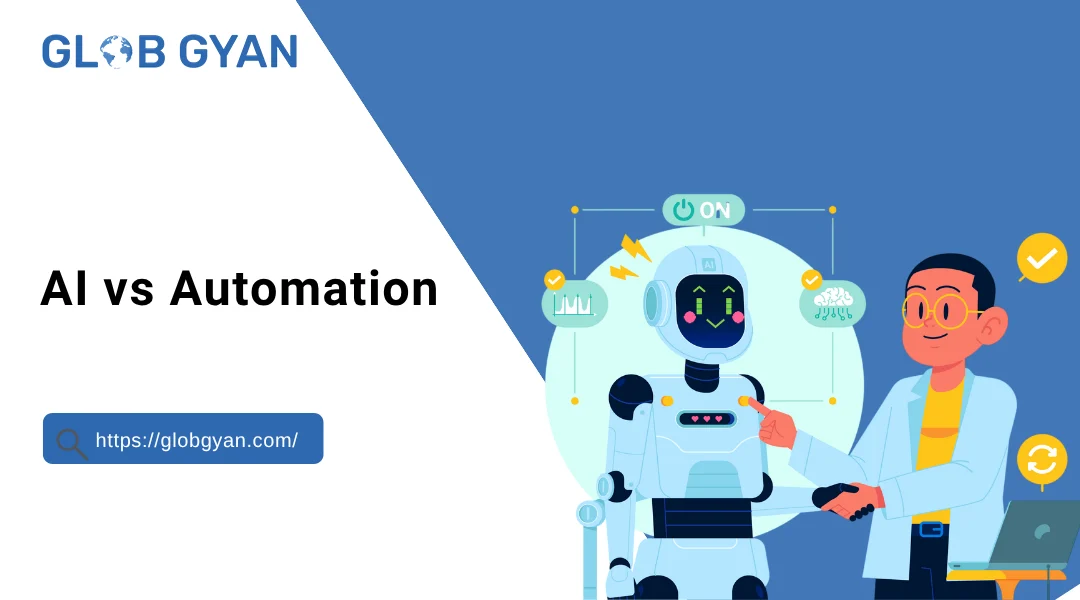
In today’s fast-growing digital world, the terms AI vs automation are used everywhere, especially in business and technology. While they may sound similar, they actually serve very different purposes.
Automation focuses on handling repetitive tasks quickly and accurately by following predefined rules. On the other hand, artificial intelligence and automation differ because AI goes a step further; it can analyze data, learn from patterns, and make decisions without constant human input.
For businesses, especially small and medium-sized ones, understanding this difference is not just technical knowledge, it’s a smart strategy. Choosing between automation, AI, or a mix of both can directly impact productivity, cost, and overall growth.
With the advancement of advanced AI automation, modern systems are now capable of handling complex data like emails, customer interactions, and reports. These systems can turn raw information into meaningful insights, helping businesses make faster and better decisions.
It’s also important to understand that AI is not just one thing. Traditional AI and machine learning have been used for years in areas like recommendations, analytics, and forecasting. But now, a new form called generative AI is changing the game by creating content, solving problems, and even assisting in coding.
In simple terms, automation helps you do tasks faster, while AI helps you do tasks smarter. And when combined, they create powerful solutions that can transform how businesses operate.
What is Automation?
Automation is the use of hardware, software, and algorithms to perform tasks automatically with minimal or no human involvement. In simple terms, the automated definition of automation is completing repetitive work using predefined rules and systems.
When we talk about AI vs automation, automation focuses on speed, consistency, and accuracy. It follows fixed instructions and does not make decisions on its own.
Automation can be divided into two main types. The first is rule-based automation, where systems follow a set of predefined steps to complete tasks. The second is more advanced, often connected with artificial intelligence and automation, where systems can adapt and improve using data.
The tasks handled by automation can vary from simple to complex. For example:
- Sending automated email responses
- Scheduling social media posts
- Managing CRM systems
- Processing business workflows
Although automation feels modern, its history goes back to the Industrial Revolution. Early inventions helped businesses reduce manual effort and improve efficiency. Over time, with the rise of computers and digital systems, automation became more powerful and widely used across industries.
Today, automation is a key part of business operations. However, with the growth of advanced AI automation, traditional automation is evolving. Systems are no longer limited to fixed rules, they can now work with intelligent technologies to handle more dynamic tasks.
This is where the concept of automated intelligence comes in. It represents the combination of automation with smart decision-making capabilities, allowing systems to perform tasks not just faster, but also more efficiently.
In the discussion of AI vs automation, it’s important to understand that automation alone is not intelligent. It executes tasks, but it does not learn or think. That’s why businesses are now moving towards combining automation with AI to create smarter and more scalable solutions.
What is Artificial Intelligence (AI)?
Artificial Intelligence (AI) is the technology that enables machines and computer systems to perform tasks that usually require human intelligence. These tasks include learning from data, recognizing patterns, making decisions, understanding language, and solving problems.
When we talk about AI vs automation, the biggest difference is how they work. Automation depends on predefined rules, while AI is driven by data. Instead of being told exactly what to do at every step, AI systems learn from large amounts of information and improve their performance over time.
At the core of AI is data. The more data an AI system receives, the better it becomes at identifying patterns and making accurate decisions. For example:
- AI can analyze customer conversations and understand sentiment
- It can study past sales data to predict future demand
- It can detect fraud by identifying unusual transaction patterns
- It can recognize images and classify them as “good” or “defective”
This is not futuristic, it is already happening through what we call narrow AI, the most common form of AI used today. You can see it in voice assistants, recommendation systems, chatbots, and fraud detection tools.
Automation vs. AI: What’s the difference?
When we talk about AI vs automation, both technologies may seem similar because they reduce human effort and improve efficiency. But in reality, they work in very different ways.
Automation is built to follow rules. AI is built to learn from data.
Understanding this difference is important because it helps businesses choose the right solution for the right problem.
Complexity and Adaptability
Automation is usually simple and rule-based. It is designed to perform specific tasks in the same way every time. It does not learn from past actions and cannot adjust if something changes.
AI, however, is more advanced and flexible. It learns from data, improves over time, and adapts to new situations. Even if the input changes, AI can analyze it and respond intelligently.
Scope of Application
Automation is best for tasks that require consistency and repetition. These tasks do not need decision-making or handling unexpected situations.
AI is used in areas where decision-making is important. It can understand speech, analyze complex data, predict trends, and even interact like humans.
Technological Foundation
Automation can be very simple or moderately complex. It may include basic software, scripts, or machines that follow instructions.
Goal Orientation
Automation is focused on performing tasks quickly and accurately without any variation. Its main goal is consistency and efficiency.
AI aims to mimic human intelligence. It focuses on making smart decisions, understanding context, and improving performance over time.
AI vs Automation: Comparison Table
| Feature | Artificial Intelligence (AI) | Automation |
| Definition | Systems that learn from data and make decisions | Systems that follow predefined rules to perform tasks |
| Purpose | To mimic human intelligence and improve decision-making | To perform repetitive tasks quickly and accurately |
| Working Style | Data-driven and learning-based | Rule-based and instruction-driven |
| Decision Making | Can make independent decisions | Cannot make decisions |
| Learning Ability | Learns and improves over time | Does not learn |
| Adaptability | Highly adaptable to new situations | Fixed and rigid |
| Task Complexity | Handles complex and dynamic tasks | Handles simple and repetitive tasks |
| Technology Used | Machine Learning, NLP, Neural Networks | Scripts, software tools, machines |
| Human Involvement | Minimal, mostly for training and monitoring | Required for setup and updates |
| Examples | Chatbots, recommendation systems, fraud detection | Email automation, data entry, scheduling |
| Goal | Intelligent, context-aware actions | Fast, consistent execution |
| Scope | Broad and flexible | Narrow and specific |
| Evolution | Continuously evolving with data | Static unless manually updated |
Similarities Between AI and Automation
Even when comparing AI vs automation, it’s important to understand that both technologies are ultimately designed with one shared objective: efficiency.
While they operate differently, their purpose aligns when it comes to improving how work gets done faster, smarter, and with fewer errors.
Shared Goals of AI and Automation
Both artificial intelligence and automation are built to optimize processes and reduce dependency on manual effort. Their core goals include:
- Reducing repetitive human work
- Increasing speed and productivity
- Minimizing errors and inconsistencies
- Scaling operations without increasing workforce size
In simple terms, both help businesses do more work in less time with fewer resources.
Impact on Work and Productivity
From factory floors to modern offices, both technologies are widely used to handle routine and time-consuming tasks.
- In manufacturing → assembling products faster and more accurately
- In offices → processing data, managing workflows, handling reports
By taking over repetitive tasks, AI and automation free up human time, allowing people to focus on:
- Strategic thinking
- Creative problem-solving
- Decision-making
Are Artificial Intelligence and Automation the Same?
This is a very common question in the discussion of AI vs automation.
The answer is no but they are closely connected.
They are not competitors. Instead, they complement each other and often work together in modern systems.
- Automation handles execution → It performs tasks based on rules
- AI handles uncertainty → It understands, learns, and makes decisions
How AI and automation work together
In many cases, basic automation is enough to handle simple tasks. For example, when you receive a message or complete an action, it can automatically trigger another step like adding a task to your to-do list or updating a spreadsheet.
But problems start when workflows become more complex.
What if you want the system to understand context?
- Understand context
- Decide priority
- Categorize information
- Respond differently based on input
This is where basic automation reaches its limit.
What if it needs to decide whether a task is urgent or not?
Intelligent Automation: The Intersection of AI and Automation
Both AI and automation are powerful on their own. But when they are combined, they create something much more effective than intelligent automation.
In simple terms, intelligent automation is where artificial intelligence and automation work together to create smarter and more efficient systems.
How AI Enhances Automation
Automation on its own is powerful but limited.
It works based on predefined rules. This means it can perform tasks quickly and accurately, but only if everything follows a fixed pattern. The moment something unexpected happens, automation cannot handle it.
This is where artificial intelligence and automation come together.
AI enhances automation by adding intelligence, flexibility, and decision-making ability.
From Rule-Based to Intelligent Systems
Traditional automation follows instructions like:
- If X happens → do Y
- If a form is submitted → send an email
This works well for repetitive tasks.
But real-world situations are rarely that simple.
Problems with basic automation:
- Cannot understand meaning
- Cannot handle variations
- Cannot make decisions
- Breaks with unexpected input
How AI Transforms Automation
When AI is integrated, automation becomes smarter.
Instead of just following rules, systems can now:
- Understand context and meaning
- Analyze large amounts of data
- Make independent decisions
- Learn and improve over time
This is what we call advanced AI automation or automated intelligence
Key Capabilities AI Adds to Automation
1. Context Understanding
AI can understand language, intent, and patterns.
Example:
- A message like “I need help urgently”
- AI understands urgency even if no specific keyword is used
2. Decision-Making
AI can choose the best action based on data.
Example:
- Prioritizing tasks (high, medium, low)
- Routing tickets to the right department
3. Learning from Data
AI improves over time by learning from past actions.
Example:
- A chatbot becomes more accurate after handling multiple queries
4. Handling Unpredictable Situations
Unlike automation, AI can deal with unknown inputs.
Example:
- Misspelled queries
- Complex customer questions
- Changing user behavior
Handling Dynamic and Complex Tasks
In real-world scenarios, workflows are rarely simple or predictable. User behavior changes, inputs vary, and situations don’t always follow predefined rules.
This is where the difference between AI vs automation becomes very clear.
Why Basic Automation Struggles
Automation is designed to follow fixed instructions.
It works well when:
- Tasks are repetitive
- Inputs are structured
- Rules are clearly defined
But in dynamic environments, problems start to appear.
Challenges with automation:
- Cannot understand different variations of the same input
- Fails when unexpected data is received
- Cannot adjust based on context
- Requires manual updates for every new scenario
For example, if a customer writes a query in a different tone or with spelling mistakes, a rule-based system may fail to respond correctly.
How AI Solves This Problem
With artificial intelligence and automation, systems become much more flexible and intelligent.
AI allows systems to:
- Understand context instead of just keywords
- Interpret different types of input
- Learn from past interactions
- Adapt to new situations automatically
AI-Powered Decision Making
One of the most important differences in AI vs automation becomes clear when we look at decision-making.
Automation is designed to execute tasks.
AI is designed to decide how those tasks should be performed.
Automation vs AI in Decision Making
Automation follows predefined rules.
Example:
- If a condition is met → perform a specific action
It does not think, analyze, or choose between options.
AI, on the other hand, evaluates situations and selects the best possible action based on data.
Example:
- Analyze customer behavior → decide what action to take
- Evaluate multiple options → choose the most effective one
How AI Makes Decisions
AI-powered automation tools rely on three main capabilities:
1. Data Analysis
AI processes large amounts of data in real time.
It can:
- Analyze customer interactions
- Study historical trends
- Evaluate multiple data points
This allows AI to make informed decisions instead of guessing.
2. Pattern Recognition
AI identifies patterns that humans might miss.
Example:
- Detecting unusual transactions (fraud detection)
- Understanding customer preferences
- Predicting future behavior
By recognizing patterns, AI can make smarter and more accurate decisions.
3. Learning Capabilities
AI continuously improves by learning from data and past actions.
Example:
- A chatbot becomes more accurate after handling more queries
- A recommendation system improves with user interaction
The Benefits of AI in Automation
When we combine artificial intelligence and automation, the result is far more powerful than using either one alone. AI-powered automation tools help businesses work faster, smarter, and more efficiently while also reducing costs and improving overall performance.
From handling repetitive tasks to making intelligent decisions, advanced AI automation is transforming how modern organizations operate.
1. Improved Operational Efficiency
One of the most important benefits of combining artificial intelligence and automation is improved operational efficiency. In simple terms, it helps businesses complete more work in less time with fewer errors. AI-powered automation systems can analyze real-time data, make decisions instantly, and execute tasks without delays. This removes bottlenecks that usually slow down workflows.
Instead of employees spending hours on repetitive and manual tasks, AI systems can handle processes like ticket management, data entry, report generation, and workflow coordination. This not only speeds up operations but also ensures consistency and accuracy. As a result, teams can focus on more important tasks like strategy and innovation, while routine work is handled automatically. Businesses can also manage higher workloads without hiring additional staff, making operations more scalable and cost-efficient.
1. How AI Improves Efficiency
- Analyzes real-time data instantly
- Makes quick and accurate decisions
- Automates repetitive tasks
- Reduces delays in workflows
2. What Tasks AI Automation Handles
- Customer support tickets
- Data processing and entry
- Workflow management
- Report generation
3. Benefits for Businesses
- Faster task completion
- Increased team productivity
- Reduced manual workload
- Fewer errors and better accuracy
- Ability to handle more work without increasing staff
For example:
Instead of employees manually handling repetitive tasks, AI systems can take over processes like ticket handling, data processing, and workflow management.
As a result:
- Work gets completed faster
- Teams become more productive
- Businesses can handle more workload without increasing staff
2. Faster and Smarter Decision-Making
AI-powered automation improves decision-making by analyzing data, identifying patterns, and predicting outcomes in real time. Unlike basic automation, which only follows rules, AI systems can make independent decisions based on insights from large datasets.
1. How AI Improves Decision-Making
- Analyzes large volumes of data
- Identifies hidden patterns
- Uses predictive analytics
- Makes real-time decisions
2. Technologies Used
- Data analysis
- Pattern recognition
- Predictive analytics
3. Business Benefits
- Faster decisions
- More accurate outcomes
- Data-driven strategies
- Reduced human errors
Example:
AI can analyze past customer behavior and predict future actions, helping businesses make better decisions in marketing, sales, and operations.
Because AI continuously learns, its decisions become:
- Faster
- More accurate
- More data-driven
This leads to better planning, improved outcomes, and reduced mistakes.
3. Significant Cost Savings
AI-powered automation helps businesses reduce costs by handling repetitive tasks automatically, minimizing the need for manual work and improving overall resource efficiency.
1. Tasks Handled by AI Automation
- Data entry and processing
- Customer support queries
- Report generation
- Internal business operations
2. How It Reduces Costs
- Minimizes manual work
- Reduces labor expenses
- Saves time and effort
- Optimizes resource usage
3. Business Benefits
- Lower operational costs
- Higher efficiency
- Better productivity
- Scalable growth without hiring
Result
- Businesses can grow faster
- Operations become cost-efficient
- More output with fewer resources
4. Increased Scalability
AI-powered automation allows businesses to handle more work without adding more people.
For example:
- A support system can handle thousands of queries automatically
- A marketing system can manage campaigns for a large audience
This means:
- More output with the same team
- Easy scaling of operations
- Better performance during high demand
5. Strong Adaptability and Flexibility
Traditional automation is rigid—it only works when everything follows fixed rules.
AI changes this completely.
With advanced AI automation, systems can:
- Adapt to new situations
- Handle unexpected inputs
- Adjust workflows automatically
Example:
If customer demand suddenly increases, AI systems can:
- Detect the change
- Adjust processes
- Optimize workflows in real time
This makes businesses more agile and competitive.
6. Better Resource Utilization
AI helps businesses use their resources more efficiently.
By automating low-value tasks, teams can focus on:
- Strategy
- Innovation
- Creative work
This leads to:
- Higher productivity
- Better decision-making
- More value-driven work
7. Enhanced Customer Experience
AI automation improves how businesses interact with customers.
Example:
- Faster responses
- Personalized communication
- Accurate problem resolution
This results in:
- Higher customer satisfaction
- Better engagement
- Stronger brand trust
How is AI Used in Automation?
AI works alongside automation to make systems smarter and more capable. While automation handles tasks like moving data or triggering actions, AI adds intelligence by analyzing that data and deciding what to do next.
For businesses, this combination of artificial intelligence and automation improves efficiency and allows systems to handle more complex and dynamic tasks.
Types of AI in Automation
AI is used in automation through different technologies that help systems learn, understand, and make decisions. These technologies turn basic automation into advanced AI automation, where systems can handle complex tasks intelligently.
1. Machine Learning (ML)
Machine Learning (ML) is one of the most important technologies used in automation, as it allows systems to learn from past data and improve their performance over time without needing manual programming. Instead of following fixed rules like traditional automation, ML analyzes large amounts of historical data to identify patterns, trends, and relationships. Based on this analysis, it can make predictions and take better decisions automatically.
In real-world applications, ML is widely used for tasks like demand forecasting, where businesses predict future product demand based on past sales data. It is also used in predictive maintenance, where systems can detect potential machine failures before they happen, helping companies avoid downtime and reduce costs. Another common use is recommendation systems, such as suggesting products, videos, or content based on user behavior.
The biggest advantage of Machine Learning in artificial intelligence and automation is that it continuously improves. As more data is collected, the system becomes more accurate and efficient. This leads to better decision-making, reduced errors, and smarter workflows, making ML a key component of advanced AI automation.
2. Natural Language Processing (NLP)
Natural Language Processing (NLP) is a key technology in automation that allows machines to understand, interpret, and respond to human language in a meaningful way. Unlike traditional systems that rely on keywords, NLP enables systems to understand the intent and context behind text or speech. It works by processing large amounts of language data, analyzing sentence structure, meaning, and patterns to generate accurate responses.
In real-world applications, NLP is widely used in chatbots and customer support systems, where it helps businesses provide instant and relevant responses to user queries. It is also used for sentiment analysis, where systems can understand whether a customer’s feedback is positive, negative, or neutral. Additionally, NLP powers voice assistants, enabling users to interact with systems using natural language instead of commands.
The biggest advantage of NLP in artificial intelligence and automation is that it creates human-like communication between machines and users. This improves customer experience, speeds up response time, and reduces the need for manual interaction. As a result, NLP plays a major role in building smarter and more interactive advanced AI automation systems.
3. Optical Character Recognition (OCR)
Optical Character Recognition (OCR) is an important AI technology used in automation that allows machines to convert printed, handwritten, or scanned text into machine-readable data. Instead of manually typing information from documents, OCR systems automatically scan images, PDFs, or paper files and extract the text in a digital format. This makes it easier for businesses to store, process, and use data efficiently.
OCR works by analyzing the visual structure of characters in an image and recognizing them as text. It can handle different formats such as invoices, forms, receipts, and handwritten notes. In real-world applications, OCR is widely used for invoice processing, document automation, and data entry tasks, where large volumes of information need to be processed quickly and accurately.
The biggest advantage of OCR in artificial intelligence and automation is that it significantly reduces manual work and saves time. It also improves accuracy by minimizing human errors and speeds up workflows by automating repetitive data entry tasks. As a result, OCR plays a key role in building efficient and scalable advanced AI automation systems.
4. Computer Vision
Computer Vision is a powerful AI technology used in automation that enables machines to understand, analyze, and interpret visual data such as images and videos. Instead of relying on manual inspection, computer vision systems can automatically detect objects, identify patterns, and recognize defects with high accuracy. It works by using algorithms and deep learning models to process visual inputs and extract meaningful information from them.
In real-world applications, computer vision is widely used in quality control within manufacturing, where it helps detect defective products quickly and accurately. It is also used in face recognition systems for identity verification and in surveillance systems for monitoring activities and ensuring security. These systems can analyze large volumes of visual data much faster than humans, making them highly efficient.
The biggest advantage of computer vision in artificial intelligence and automation is its ability to improve accuracy and reduce human error in visual inspections. It speeds up processes, ensures consistency, and enhances overall productivity. As a result, computer vision plays a crucial role in building smarter and more reliable advanced AI automation systems.
5. Robotics in AI
Robotics combined with AI is a powerful technology used in automation where intelligent software is integrated with physical machines to perform tasks in real-world environments. Unlike traditional robots that follow fixed instructions, AI-powered robots can analyze their surroundings, adapt to changes, and perform tasks more efficiently. They use data, sensors, and machine learning to make decisions and improve their performance over time.
In real-world applications, Robotics in AI is widely used in manufacturing processes for assembling products, in warehouse operations for sorting and managing inventory, and in hazardous environments where human involvement can be risky. These robots can handle repetitive, complex, or dangerous tasks with precision and consistency.
The biggest advantage of Robotics in artificial intelligence and automation is that it increases operational efficiency while reducing human risk. It minimizes errors, speeds up processes, and ensures safety in environments that are not suitable for humans. As a result, Robotics + AI plays a key role in building advanced and scalable AI automation systems.
6. Expert Systems
Expert systems are a type of AI technology used in automation that simulate human decision-making using predefined rules, logic, and knowledge. These systems are designed to solve problems and provide solutions in a way similar to a human expert. They work by using a knowledge base (stored information) and a set of rules to analyze situations and make decisions.
In real-world applications, expert systems are widely used in medical diagnosis to help identify diseases based on symptoms, in technical problem-solving to troubleshoot issues, and in business decision support to guide strategies and operations. These systems can quickly process large amounts of information and provide accurate recommendations.
The biggest advantage of expert systems in artificial intelligence and automation is that they deliver fast, consistent, and reliable decisions without human intervention. They help reduce errors, save time, and improve efficiency, making them an important part of advanced AI automation systems.
7. Predictive Analytics
Predictive analytics is an important AI technology used in automation that helps businesses forecast future outcomes by analyzing past data, trends, and patterns. Instead of just reacting to current situations, predictive analytics allows systems to anticipate what might happen next. It works by using data, statistical models, and machine learning algorithms to study historical information and identify patterns that can predict future behavior.
In real-world applications, predictive analytics is widely used for sales forecasting, where businesses estimate future demand based on past performance. It is also used in risk analysis to detect potential threats or financial risks, and in supply chain planning to ensure smooth operations by predicting inventory needs and delivery timelines. These insights help organizations make proactive decisions rather than reactive ones.
The biggest advantage of predictive analytics in artificial intelligence and automation is that it improves planning and decision-making. It enables businesses to reduce uncertainty, optimize resources, and achieve better outcomes. As a result, predictive analytics plays a key role in building smarter and more efficient advanced AI automation systems.
8. Speech Recognition
Speech recognition is an AI technology used in automation that converts spoken language into text or actionable commands, allowing machines to understand and respond to human voice input. Instead of typing or clicking, users can interact with systems using voice, making processes faster and more convenient. This technology works by capturing audio input, analyzing sound patterns, and translating them into machine-readable language using AI models.
In real-world applications, speech recognition is widely used in voice assistants like Alexa and Siri, automated call systems, and voice-controlled devices. It enables users to perform tasks such as searching information, controlling devices, or giving commands without manual input. This is especially useful in situations where hands-free interaction is required, such as driving or multitasking environments.
The biggest advantage of speech recognition in artificial intelligence and automation is that it improves user experience by making interactions faster, easier, and more natural. It reduces the need for manual effort and increases accessibility, making systems more efficient and user-friendly. As a result, speech recognition plays an important role in building modern advanced AI automation solutions.
Use Cases for Intelligent Automation Tools
Businesses today are using artificial intelligence and automation together to improve efficiency, reduce manual work, and deliver better experiences across different departments. Intelligent automation helps companies handle repetitive tasks, make faster decisions, and scale operations without increasing workload.
1. Human Resources (HR)
In HR, advanced AI automation helps streamline hiring and employee management processes. Many repetitive tasks can be automated, allowing HR teams to focus on strategic activities like talent development and employee engagement.
Common use cases:
- Scheduling interviews automatically
- Creating job descriptions and job postings
- Comparing candidates from multiple platforms
- Assisting with onboarding (tool access, payroll setup)
- Personalizing onboarding based on employee data
Result:
HR teams save time, reduce manual effort, and improve hiring efficiency.
2. Engineering Teams
For engineering teams, intelligent automation provides centralized access to information and automates routine technical tasks. It helps engineers work faster and reduces the time spent searching for data or handling system issues.
Common use cases:
- Centralized search for documents and technical data
- Real-time system monitoring and alerts
- Automatic notifications for performance issues
- Provisioning cloud resources like servers and databases
Result:
Engineers can focus more on development and innovation instead of repetitive tasks.
3. Customer Service
Customer service is one of the most powerful use cases of AI-powered automation. It enables businesses to provide instant and efficient support without depending entirely on human agents.
Common use cases:
- Chatbots for instant replies
- Automated ticket routing and handling
- Self-service support systems
- AI-based issue resolution
Result:
Faster responses, reduced workload, and improved customer satisfaction.
4. Sales Support
AI automation also enhances sales processes by improving communication and providing quick access to customer data.
Common use cases:
- Instant answers to customer queries
- Centralized information for follow-ups
- Personalized communication based on user behavior
Result:
Sales teams work more efficiently and close deals faster.
AI vs Automation vs Human Power: They Work Together
When we talk about AI vs automation vs human power, it’s important to understand that these are not competing options. It’s not about choosing one over the other. In reality, they work best when used together.
AI, automation, and humans each have their own strengths. Automation is great at handling repetitive tasks quickly and consistently. AI adds intelligence by analyzing data, learning patterns, and making decisions. Humans bring creativity, critical thinking, and emotional understanding to things that machines cannot fully replicate.
Instead of replacing human work, artificial intelligence and automation are designed to support it. Automation takes care of routine tasks, AI handles complex decision-making, and humans focus on strategy, innovation, and problem-solving.
When combined:
- Automation handles execution
- AI handles intelligence
- Humans handle creativity and judgment
This collaboration creates more powerful and efficient systems. Businesses can save time, improve productivity, and make better decisions while still relying on human expertise where it matters most.
Common Mistakes Businesses Make with AI and Automation
Many businesses adopt AI and automation with high expectations, but often fail to see real results due to common mistakes. Understanding these issues can help organizations use artificial intelligence and automation more effectively.
1. Focusing on Tools Instead of Problems
One of the biggest mistakes is starting with tools instead of identifying real business problems. Companies often invest in advanced platforms without a clear use case.
Issue:
They end up with impressive dashboards but little real impact on operations.
Right approach:
Start by identifying specific problems, then choose the right solution.
2. Automating Inefficient Processes
Automation works best when processes are already clear and optimized. If a workflow is confusing or poorly designed, automation will only make it worse.
Issue:
- Errors increase
- Inefficiencies get repeated
- AI may learn incorrect patterns
Right approach:
Fix and simplify processes before applying automation.
3. Ignoring Change Management
Many employees resist AI and automation, not because of the technology, but because of fear of losing control or jobs.
Issue:
Low adoption and internal resistance.
Right approach:
Position AI as a support system that helps employees, not replaces them.
4. Poor Data Quality
AI systems depend heavily on data. If the data is inaccurate or incomplete, the results will also be unreliable.
Issue:
- Wrong insights
- Poor decision-making
- Ineffective automation
Right approach:
Ensure clean, structured, and high-quality data before implementing AI.
5. Expecting Instant Results
Unlike basic automation, AI systems take time to learn and improve.
Issue:
Businesses expect perfect results immediately and give up too early.
Right approach:
Allow time for learning, feedback, and continuous improvement.
Conclusion
To sum it up, understanding the difference between AI vs automation is essential in today’s digital world. Both technologies play an important role, but they serve different purposes.
Automation is designed to handle repetitive and rule-based tasks quickly and efficiently. It saves time and reduces manual effort by following predefined instructions. On the other hand, artificial intelligence adds intelligence to these systems. AI can analyze data, learn from patterns, and make decisions, allowing systems to handle more complex and dynamic situations.
When these two technologies are combined, they create intelligent automation, where systems not only perform tasks but also think, adapt, and improve over time. This combination helps businesses build smarter workflows, improve productivity, and scale operations more effectively.
Understanding artificial intelligence and automation is not just important for businesses—it is valuable for everyone. Whether you are a student learning new skills, a freelancer looking to improve efficiency, or a business owner aiming to grow faster, these technologies can give you a strong competitive advantage.
FAQs
Automation follows predefined rules to perform tasks, while AI can learn from data, make decisions, and adapt to new situations.
AI is more advanced than automation. It can be part of automation systems, but it adds intelligence and decision-making capabilities.
Intelligent automation is the combination of AI and automation, where AI makes decisions and automation executes tasks.
AI is used in automation to analyze data, recognize patterns, and make decisions using technologies like machine learning, NLP, and computer vision.
AI in automation improves efficiency, reduces costs, enables faster decision-making, and helps businesses scale operations easily.
Yes, basic automation can work without AI, but it is limited to rule-based tasks and cannot handle complex situations.
Advanced AI automation refers to systems that combine automation with AI to create intelligent, self-improving workflows.
Examples include chatbots, recommendation systems, automated email marketing, fraud detection, and smart customer support systems.
AI is more flexible because it can learn, adapt, and make decisions, while automation is limited to fixed rules.
Students, freelancers, and business owners should learn AI and automation to improve productivity, skills, and career opportunities.