




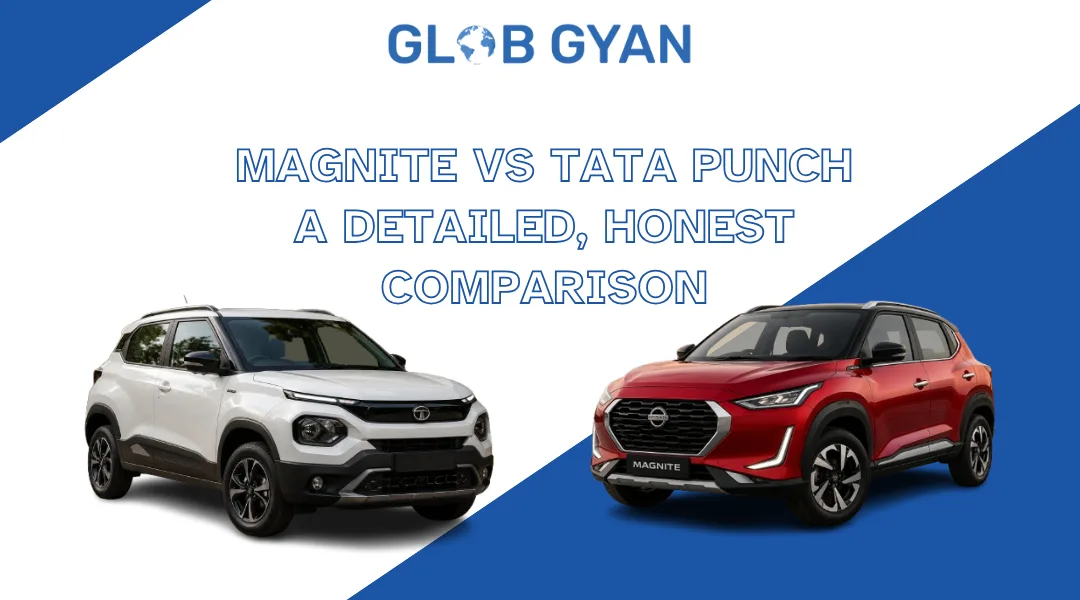
Choosing between the Nissan Magnite and Tata Punch is one of the most common dilemmas in the Indian car market today. Both sit in the same price band, both wear the SUV badge and both target first-time car buyers as well as young families. But they are very different products underneath the surface.
This comparison covers everything that matters — price, engine, safety, features, space and real-world suitability – so you can make the right choice without regret.
Quick Overview: Who Makes What
The Nissan Magnite is a sub-4-metre SUV from Nissan India, first launched in 2020 and refreshed with a facelift in 2024. It is made in India at Nissan’s Oragadam plant in Chennai and is also exported to other markets.
The Tata Punch is a micro-SUV from Tata Motors, launched in October 2021. It sits on Tata’s ALFA architecture — the same platform that underpins the Altroz hatchback — and has quickly become one of the best-selling cars in India.
Tata sold 2,02,030 units of the Punch in 2025 alone, making it a genuine market phenomenon. The Magnite, while smaller in volume, has also carved a loyal customer base thanks to aggressive pricing and strong features.
Price Comparison
The Nissan Magnite price starts at Rs 5.65 lakh (ex-showroom) and the Tata Punch also starts at Rs 5.65 lakh (ex-showroom) — practically identical at entry level.
However, the gap widens as you go higher:
The new Nissan Magnite ranges between Rs 5.99 lakh and Rs 11.50 lakh (ex-showroom).
The Punch’s top variant is Rs 1.35 lakh more affordable than the facelifted Magnite’s top variant.
This means if you are looking at well-equipped variants, the Punch actually ends up being the cheaper option despite appearing to be the premium product. Keep this in mind when you compare spec sheets.
Engine and Performance
This is where the two cars take very different paths.
Nissan Magnite comes with two petrol engine options. The base engine is a 1.0-litre naturally aspirated 3-cylinder unit producing 72 hp and 96 Nm of torque. The more interesting option is the 1.0-litre turbo-petrol engine producing 100 hp and 152 Nm, available with either a 5-speed manual or a CVT automatic gearbox.
The Magnite also comes with a 100 PS 1-litre turbo-petrol engine, which gets the option of a CVT automatic along with a manual transmission.
Tata Punch uses a larger 1.2-litre naturally aspirated 3-cylinder engine producing 88 hp and 115 Nm. The Punch is powered by a 1.2-litre 3-cylinder petrol engine producing 88 hp and 115 Nm, paired with either a 5-speed manual or AMT gearbox. In CNG form, it delivers 73.5 hp and 103 Nm.
Key difference: The Magnite’s turbo engine gives noticeably sharper throttle response and feels more eager on highways. The Punch’s naturally aspirated unit is smoother and more refined for stop-and-go city driving. The Punch’s AMT gearbox is easier to use in traffic than the Magnite’s base automatic, but the Magnite’s CVT is the smoothest automatic option in this comparison.
If you mostly drive in the city, both engines work well. If you travel frequently on highways or want a peppy drive, the Magnite’s turbo variant wins convincingly.
Dimensions and Space
The Nissan Magnite is 4 metres long, 1.75 metres wide and 1.5 metres high, with a 2,500 mm wheelbase.
The Tata Punch dimensions are 3,827 mm length, 1,742 mm width, and 1,615 mm height, with a 2,445 mm wheelbase.
The Magnite is noticeably longer, wider, and has a longer wheelbase. This directly translates to a roomier rear seat and more shoulder room for all passengers.
However, the Punch is taller. The Punch is taller and has a slightly larger boot space on paper. In reality:
The Magnite offers boot space of 336 litres, expandable to 690 litres.
The Punch’s boot space stands at 366 litres, lower in CNG variants due to the twin-cylinder tanks.
So the Punch edges ahead on boot space in standard petrol form (366 L vs 336 L), but the Magnite’s rear seats fold to give 690 litres of cargo room — very useful for road trips.
If you regularly carry four adults: The Magnite’s wider cabin and longer wheelbase give rear passengers more comfort.
If you are taller than 6 feet: The Tata micro-SUV will accommodate you better, thanks to its greater height.
Ground Clearance
The Magnite ground clearance is 205 mm, making it suitable for varied road conditions.
The Tata Punch comes with a ground clearance of 187 mm — a meaningful difference of 18 mm. On rough roads, broken surfaces, or waterlogged streets (which Indian cities see plenty of during monsoon), the Magnite’s higher ground clearance gives extra peace of mind.
Safety Ratings — A Critical Section
Safety is one of the most important factors for Indian buyers, and this is where the two cars tell very different stories.
Tata Punch: The 2024 model boasts a 5-star safety rating for adult occupant protection and a 4-star rating for child occupant protection from Global NCAP. More recently, the Tata Punch secured a five-star safety rating under the Bharat New Car Assessment Programme (BNCAP), with an impressive 30.58 points out of a maximum of 32 in Adult Occupant Protection
Nissan Magnite: The Magnite recently scored a 5-star safety rating from Global NCAP. This is a significant upgrade from its earlier ASEAN NCAP 4-star score and makes the Magnite a much more credible safety proposition now
Both cars now carry 5-star safety ratings, which is excellent news for buyers. The standard Magnite variants come with 6 airbags, while the Punch’s base variants offer 2 airbags. As you move up the trim levels, both cars improve their safety equipment significantly.
Bottom line on safety: Both cars are safe. The Punch has a longer track record in independent crash testing. The Magnite’s recent 5-star result levels the playing field considerably.
Features Comparison
Both cars pack an impressive list of features for their price. Here is how they compare across key areas:
Infotainment: The Magnite’s top variant gets an 8-inch touchscreen with wireless Android Auto and Apple CarPlay. The Punch’s top variant gets a larger 10.25-inch touchscreen — a clear win for Tata here
Digital Cluster: The Punch’s top model offers a 7-inch digital driver’s display. The Magnite also gets a digital instrument cluster on higher variants
Sunroof: The Punch top model offers a single-pane sunroof. The Magnite does not offer a sunroof, which is a notable omission at the top trim level
Climate Control: The Punch top model includes automatic climate control with rear AC vents. Rear AC vents are a practical advantage for passengers sitting in the back
360-degree Camera: The Magnite comes with a 360-degree camera. The Punch does not offer a 360-degree camera, which gives the Magnite an edge for parking in tight spaces
Wireless Charging: The Punch offers a wireless phone charger on top variants, as does the Magnite
Fuel options: Both cars now offer CNG variants. The Nissan Magnite is available with 2 fuel type options — Petrol and CNG — and the Tata Punch is also available in Petrol and CNG
Ride Quality and Real-World Driving
The Magnite rides on a longer wheelbase with a softer suspension setup that absorbs bumps well on highways. It feels planted at high speeds and handles undulations without drama. In the city, the suspension is slightly bouncy over sharp speed bumps, but nothing uncomfortable.
The Punch has a more upright, tall body and a slightly stiffer ride. It handles city roads and rough patches confidently. Its taller stance makes boarding and alighting easy, especially for older passengers and those with knee issues. The steering on the Punch feels more direct and confidence-inspiring in tight corners.
After-Sales Service and Ownership Cost
This is where you need to think beyond the showroom. Tata Motors has a significantly larger dealer and service network across India, especially in Tier 2 and Tier 3 cities. If you live outside a major city, Tata’s reach means you are never far from a service centre.
Nissan’s dealer network, while improving, is still smaller in comparison. However, Nissan India has been actively expanding its presence, and ownership costs for the Magnite remain competitive with service intervals of 10,000 kilometres.
For long-term ownership, the Punch’s resale value is also stronger, driven by the Tata brand’s growing reputation and high sales volumes that keep the used car market active.
Who Should Buy Which Car?
Buy the Nissan Magnite if:
- You want more interior space, especially for rear passengers
- Highway driving and long road trips are a priority
- You want a turbo-petrol engine with a CVT for effortless city and highway performance
- A 360-degree parking camera matters to you
- You are buying on a tighter budget and want more car for the money at mid-spec variants
Buy the Tata Punch if:
- Safety is your top priority and you want a long track record at NCAP
- You prefer a larger touchscreen and a sunroof
- Your family includes elderly passengers who need an easier entry and exit
- You want CNG with an automatic gearbox (Punch offers CNG with AMT)
- You value strong after-sales support and better resale value
- You want rear AC vents for passenger comfort
At The End
The Nissan Magnite and the Tata Punch are two of the strongest value propositions in the Indian car market. They are not identical products and they serve slightly different needs.
The Magnite wins on driving fun, interior space, ground clearance, and the availability of a proper CVT with turbo power. It feels like a bigger car from the inside and covers ground effortlessly on the highway.
The Punch wins on the sunroof, touchscreen size, safety history, rear comfort features, brand reliability, and overall ownership peace of mind. It also sells in far higher numbers — which itself signals something about mass-market confidence.
If budget is tight and you want performance: choose the Magnite Turbo. If safety, features, and brand trust are your top priorities: choose the Tata Punch. Either way, you are getting a very good car for the money — and that is the best thing about this segment