





What this guide covers
A certificate of analysis, or COA, is a one or two page document that comes with a batch of a research chemical. It is the batch’s report card. Most people glance at it, see a big percentage, and move on. That skips almost everything useful. Retatrutide is the example throughout, because it is one of the most widely sold research peptides online and its certificates vary more from seller to seller than any other compound I deal with. This guide goes down a typical Retatrutide COA from the top of the page to the signature at the bottom and explains what each field means, why it is there, and what a good entry looks like. Keep a real certificate open beside you while you read. It will make more sense that way.
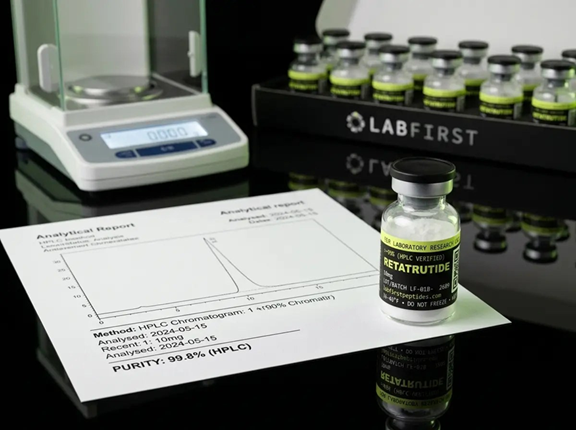
How LabFirst Peptides tests each research lot
What sits in the header, and why does it matter?
The header is the part people skip, and it carries the details that tie the whole document to something real.
- Document title and number. A COA should have its own reference number. That lets anyone ask the issuer about this exact report later.
- Issuer name and contact details. Who produced the document. You want a real address and a way to reach them.
- Issue date. When the certificate was written. Keep this separate in your head from the test date, which comes later.
If the header is blank or generic, the rest of the page has nothing to stand on.
What does the product information section tell you?
This block describes the material itself. Expect to see:
- Product name. The common name of the compound.
- Sequence or chemical formula. For a peptide, the order of its amino acids, or its molecular formula. This is what the identity test will be checked against.
- Molecular weight. The expected mass of one molecule. Write this number down. You will use it in a minute.
- Lot or batch number. The single most important line on the page. It links this report to one specific production run.
- Quantity or fill. How much material each unit is supposed to hold.
- Appearance. Usually something like “white lyophilized powder.” A simple visual check.
That lot number should match the label on the product exactly. Same letters, same digits, same order. If it does not match, the certificate is about a different batch. I have had a certificate land with a lot number that did not match the vial on my bench. It happens more than you would think, and it is usually a filing mistake rather than fraud, but you cannot tell which from the paper.
What is in the test results table?
This is the heart of the document. Each row is one test. Most tables have the same few columns:
- Test. What was checked, such as identity or purity.
- Method. How it was checked, such as mass spectrometry or HPLC.
- Specification. The pass mark, decided before testing. For purity, something like “at least 98%.”
- Result. What the sample measured.
- Status. Whether the result met the specification.
Read every row. The purity row gets the attention. The others matter as much.
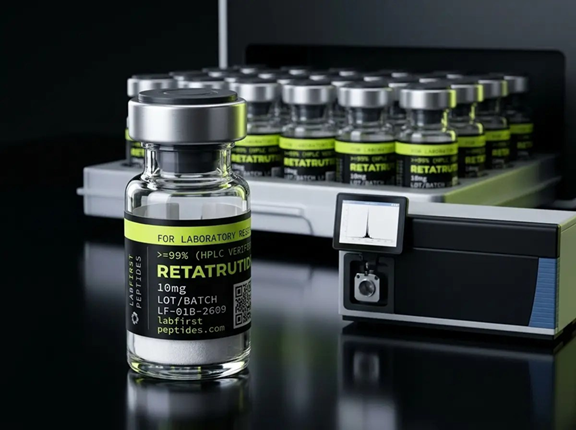
Mass spectrometry identity check on a Retatrutide research lot, LabFirst Peptides
How do you read the identity row on a Retatrutide COA?
The identity row should show a measured mass from mass spectrometry. Go back to the molecular weight you noted in the product section. The two numbers should be very close, usually within a small fraction of a unit.
If the identity row only says “conforms” with no number, you are being asked to take it on trust. A number you can compare is better.
How do you read the purity row and the chromatogram?
The purity row usually comes from HPLC. The result is a percentage: how much of the sample is the main compound versus everything else.
Many COAs attach a chromatogram, which is the graph the instrument produced. It looks like a flat line with spikes. A clean sample has one tall spike and very small bumps around it. The purity percentage is the tall spike’s share of the total area under all the spikes.
Look for a small table under the graph listing each peak, its retention time, and its area percentage. That table is where the headline number comes from.
What else might appear lower on the page?
Depending on the material, you might see:
- Water content. Freeze-dried powders still hold a little moisture.
- Peptide content. How much of the powder’s weight is peptide, as opposed to salts and water. This is different from purity, and people mix the two up constantly.
- Storage conditions. Recommended temperature and how to keep the material stable.
- Test date. When the lab work was done. This should be recent relative to the batch.
What belongs at the bottom?
The sign-off. A name, a title, and a signature or approval line from whoever reviewed the results. Some COAs also include a verification code or link that lets you confirm the document with the issuer directly. If one is there, use it.
The five-minute check
- Find the lot number and confirm it matches the product label exactly.
- Note the expected molecular weight from the product section.
- Check the identity row for a measured mass and compare the two numbers.
- Read the purity row and glance at the chromatogram for one dominant peak.
- Check the test date against when the batch was made.
- Look for a named reviewer and a working verification route.
- Save a copy with your order records.
You can see a full worked example in the retatrutide certificate of analysis walkthrough, and compare it with the live certificates of analysis page where current lot documents are posted.
What should you check before trusting a COA?
- The lot number matches the product, character for character
- Identity is reported with a measured value you can compare
- Purity and peptide content are kept separate
- The test date is recent and makes sense for the batch
- The same certificate is not being used for several different products
- Someone is named as responsible for the results
Bottom line
A COA is easy to read once you know where to look. Start with the lot number, check identity against the expected mass, then read purity in context. Skip the header and you might be reading about the wrong batch entirely. If you want to see these fields in their natural habitat, the retatrutide peptide listing shows how lot documents connect to a product.
Questions I get asked
Is a COA the same as a lab report?
Close. A COA summarizes lab results for one batch in a standard format.
What if a COA has no chromatogram?
It can still be valid, but you have less to check. Ask for it.
Do COAs expire?
The document doesn’t. Its relevance fades as the batch ages.
Research compounds discussed here are sold for laboratory research use only and are not intended for human or animal use. This guide is not medical advice.
Disclaimer: This article is for informational and educational purposes only. It explains how to read a certificate of analysis (COA) and does not provide medical advice, diagnosis, or treatment recommendations. Retatrutide and other research compounds mentioned here are discussed as laboratory research materials only. They are not approved for human or animal use, and nothing in this guide should be taken as encouragement to use, buy, or consume them. Glob Gyan does not sell these products and does not verify the quality, legality, or test results of any third-party seller or certificate. Laws and regulations around research compounds differ by country, so please check the rules that apply to you. If you have questions about your health or any medication, speak to a qualified healthcare professional. Links to third-party websites are provided for reference only, and any action you take based on this content is at your own risk. Glob Gyan shall not be held liable for any loss, damage, or inconvenience arising from the use of this content or any resources referenced herein.
This article may contain sponsored or partner links. Glob Gyan may receive compensation if you visit or purchase through them, at no extra cost to you.