




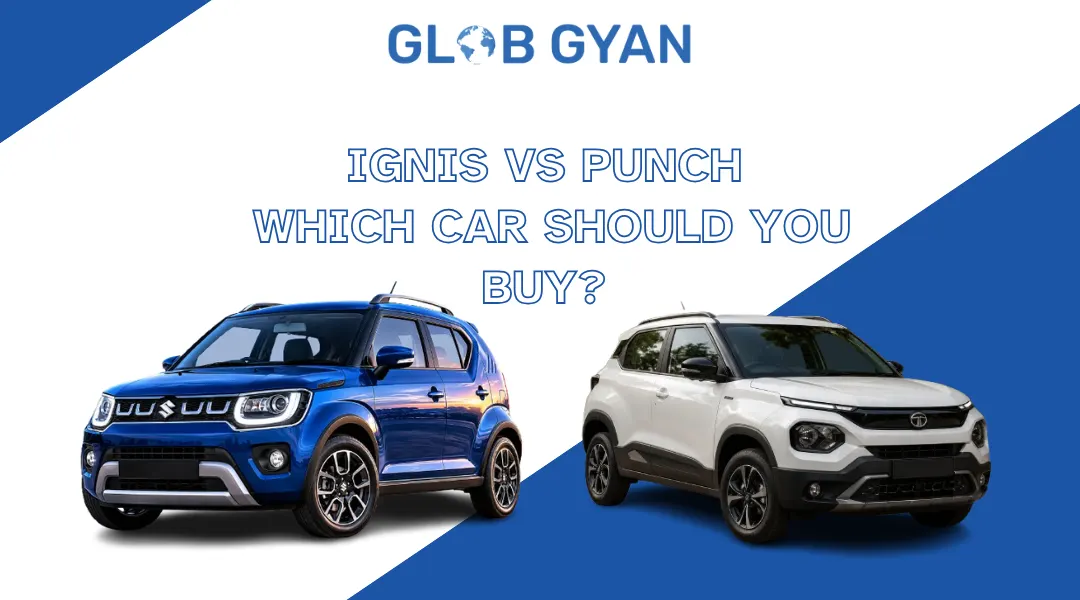
After comparing so many options, you may find yourself choosing between two popular cars that offer great value for money. Maruti Suzuki Ignis and Tata Punch. Smart shortlist, honestly. Both sit in a similar price range both are compact and both have a loyal following. But they are very different cars underneath that surface-level similarity.
If you’re sitting on the fence, this Ignis vs Punch comparison will help you get off it.
A Quick Look at the Two Contenders
The Maruti Suzuki Ignis is a quirky urban hatchback sold through the Nexa premium channel. It’s been around since 2017, has a distinctive boxy design and is aimed at younger city buyers who want something that stands out without burning a hole in their pocket.
The Tata Punch, launched in 2021, is a micro-SUV with proper SUV styling, a tall stance, and Tata’s well-earned reputation for safety. It’s one of the bestselling cars in its segment and carries a 5-star Global NCAP safety rating – which is a big deal.
Ignis vs Punch: Price Comparison
This is usually where the conversation starts.
The Maruti Suzuki Ignis starts at ₹5.35 lakh (ex-showroom) for the base Sigma variant and tops out at around ₹7.42 lakh for the Alpha AMT. It’s a tight, well-priced range.
The Tata Punch starts slightly higher at ₹5.50–5.65 lakh for the base petrol and stretches all the way to ₹9.60 lakh for the top Creative Plus AMT variant. There’s also a CNG option ranging from ₹7.10 lakh to ₹9.68 lakh.
Verdict: If budget is your primary concern, the Ignis has a slight edge at the entry level. But the Punch offers more variant spread – you can load it up with features if you’re willing to spend more.
Engine and Performance
Both cars run a 1.2-litre petrol engine but the details differ.
| Specification | Maruti Ignis | Tata Punch |
| Engine Displacement | 1197 cc | 1199 cc |
| Engine Type | 1.2L, 4-Cylinder DOHC Petrol | 1.2L, 3-Cylinder SOHC Petrol |
| Maximum Power | 82 bhp @ 6000 rpm | 86 bhp @ 6000 rpm |
| Maximum Torque | 113 Nm @ 4200 rpm | 113 Nm @ 3300 rpm |
| Transmission Options | 5-Speed Manual / 5-Speed AMT | 5-Speed Manual / 5-Speed AMT |
| Drive Type | Front-Wheel Drive (FWD) | Front-Wheel Drive (FWD) |
| Engine Refinement | Smoother due to 4-cylinder setup | Slightly more vibration due to 3-cylinder setup |
| Low-End Performance | Good for city driving | Better low-end torque delivery |
| Best Suited For | Smooth urban commuting | City and occasional highway driving |
The Punch’s torque arrives earlier (3300 rpm vs 4200 rpm), which makes it feel punchier in city traffic — no pun intended. The Ignis is rev-happy and feels more spirited at higher speeds. Neither car is particularly fast, but both are perfectly adequate for everyday use.
The Punch also offers a CNG variant if fuel economy is a major priority for you.
Verdict: The Punch has a slight real-world performance advantage in the city. The Ignis is more fun if you like pushing the engine a bit.
Mileage: Ignis vs Punch
The Ignis claims a fuel efficiency of 20.89 kmpl (ARAI rated), which is genuinely impressive for a petrol hatchback.
The Punch’s petrol figures are competitive but vary across variants. The CNG version of the Punch, however, is significantly more economical over the long run and makes a compelling case for high daily commuters.
Verdict: The Ignis edges it on pure petrol efficiency numbers. But if you drive a lot, the Punch CNG might change the math entirely.
Dimensions and Space
This is where the two cars start to diverge quite noticeably.
| Length | 3,700 mm | 3,827 mm |
| Width | 1,690 mm | 1,742 mm |
| Height | 1,595 mm | 1,615 mm |
| Wheelbase | 2,435 mm | 2,445 mm |
| Boot Space | 260 litres | 366 litres |
| Ground Clearance | 180 mm | 187 mm |
The Punch is noticeably bigger and that shows inside the cabin too. The boot space difference is significant: 366 litres vs 260 litres. If you’re someone who travels with luggage, sports gear or groceries for a family, the Punch wins comfortably.
The Ignis isn’t cramped by any means it seats four adults in reasonable comfort but the Punch simply offers more room.
Verdict: The Punch wins on space, ground clearance, and road presence. The Ignis is more manoeuvrable in tight city lanes.
Design and Styling
This is entirely subjective but worth talking about.
The Ignis has a cult following for its unconventional, angular design. It’s small, funky, and refuses to look like anything else on the road. It’s available in dual-tone combinations like Nexa Blue with Black Roof and Lucent Orange with Black Roof that look genuinely sharp.
The Punch has proper micro-SUV proportions — tall stance, squared-off wheel arches, and an assertive front face. It looks like a mini-SUV without apologising for it. The colour options like Calypso Red with White Roof and Atomic Orange are vibrant and popular.
Verdict: If you want something quirky and urban, the Ignis. If you want something that looks muscular and SUV-like, the Punch.
Safety: A Clear Winner Here
This is where the comparison gets decisive.
The Tata Punch holds a 5-star Global NCAP safety rating, the highest possible. For a car in this price segment, that’s extraordinary. Tata has been serious about safety across its line-up and the Punch reflects that.
The Maruti Suzuki Ignis, unfortunately, scored poorly in recent Global NCAP crash tests. This is a significant concern, especially for buyers who prioritise occupant protection.
Verdict: The Punch wins this category, and it’s not close. If safety is your number one priority (and it should be), the Punch is the stronger choice.
Features Comparison
Both cars offer a touchscreen infotainment system, Bluetooth connectivity, reverse camera, and power windows in their mid and top variants.
The Ignis, being a Nexa product, gets a more premium interior feel with the Smartplay Studio infotainment system and a generally clean, youthful cabin layout.
The Punch offers features like multiple drive modes (City, Eco, Sport) on select variants, which adds a bit of versatility to the driving experience.
Verdict: Broadly similar at equivalent price points. The Ignis feels slightly more premium inside; the Punch offers more feature depth at higher trims.
Ignis vs Punch: Who Should Buy What?
Here’s the honest summary:
Buy the Maruti Ignis if:
– You primarily drive in the city and want something nimble and easy to park
– You want the lower starting price and better entry-level value
– You love its quirky, distinctive design
– Fuel efficiency on petrol matters a lot to you
– You trust Maruti’s massive service network
Buy the Tata Punch if:
– Safety is a non-negotiable priority for you or your family
– You want more boot space and a larger cabin
– You prefer the look and feel of a mini-SUV
– You’re open to the CNG variant for long-term savings
– You want better ground clearance for occasional bad roads
Final Remarks
The Ignis vs Punch debate doesn’t have a universal answer but the Punch has a stronger all-round case for most buyers in 2026. Its safety ratings, boot space and road presence give it an edge that’s hard to ignore.
The Ignis, however, remains a genuinely charming and practical car for the urban buyer who values character, efficiency and a lower price tag. It’s not the wrong choice – it’s just a more specific one.
Drive both before you decide. You’ll know within 10 minutes which one feels like yours.
Prices mentioned are ex-showroom and may vary by city and variant. Always check the latest on-road price with your local dealer.