




The electric vehicle (EV) industry has moved past the early-adoption phase and into a data-intensive, software-defined era. The numbers tell the story: U.S. registrations have climbed past the 3.5-million mark, charging infrastructure now spans tens of thousands of stations nationwide and government safety agencies are quantifying, in precise percentage terms, how much digital technology could reduce road fatalities. In 2026, electric vehicles are no longer defined solely by battery capacity — they are defined by the volume of data they generate, process, and act upon in real time.
Market Growth by the Numbers
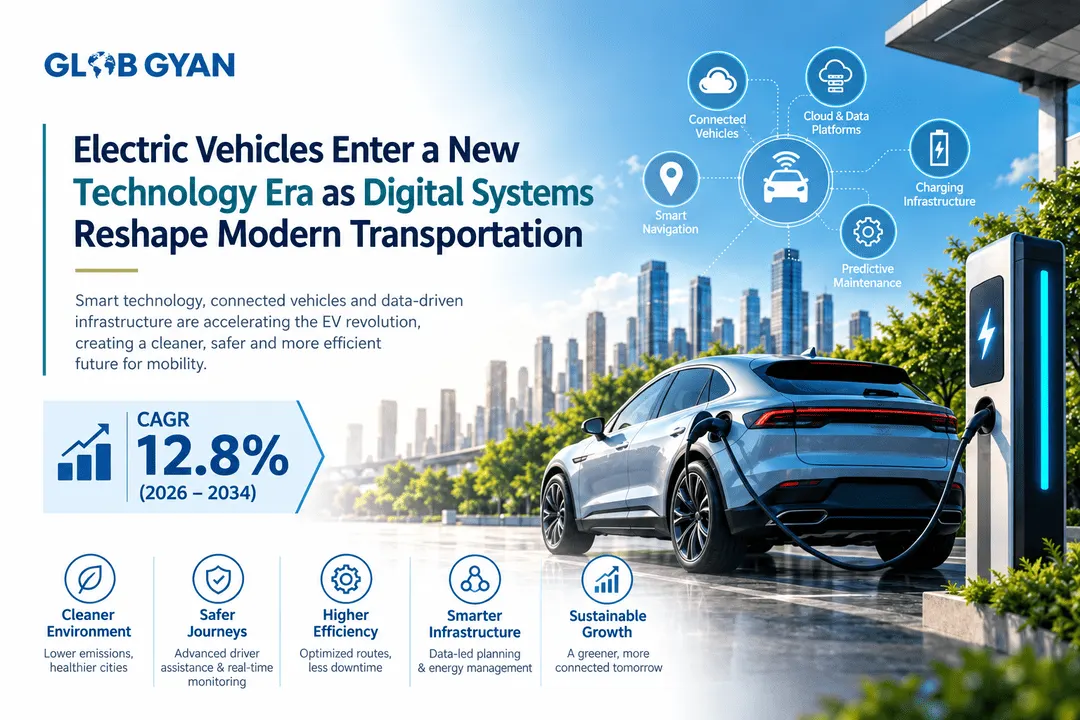
According to Dataintelo, the global Electric Vehicles (EV) market was valued at USD 641.2 billion in
2025 and is projected to reach approximately USD 1,847.3 billion by 2034, expanding at a CAGR of
12.8% from 2026 to 2034.
Market segmentation also shows significant changes in the EV segment. The largest share of the EV segment belongs to battery electric vehicles with 48.3% in 2025, whereas Asia Pacific is the leading geography with a total of 42.1% of the global revenue. Other than the mentioned EV segment aspects, the report also covers vehicle types, components, propulsion technologies, the charging infrastructure, vehicle classes, end users and the major regions in order to capture the fact that the growth of EV is widespread rather than targeted.
| What’s Changing | Data Point |
|---|---|
| EV market expansion | USD 856.4B → USD 3,801.2B |
| Annual growth rate | 18.2% CAGR |
| BEV dominance | 48.3% share in 2025 |
Previously, Fortune Business Insights made volume forecasts regarding EVs globally, estimating the number of the EV units sold to grow from 8.6 million in 2018 to 40.6 million in 2026.
U.S. Registration Data: A Measurable Surge
Government statistics deliver some of the strongest proof of the fast rate of adoption. Specifically, the U.S. Department of Energy’s Alternative Fuels Data Center (AFDC) reported that U.S. electric vehicle registrations grew from just about 2,442,300 in 2022 to 3,555,900 in 2023, which is a year-on-year growth of only 45.6%. Hence, there were 1.1 million more electric vehicles countrywide in one year. This most recent development also increased the number of electric vehicles to about 1.40% of the total of over 287 million vehicles registered as of that date, compared to just over 1.0% the previous year.
State-by-state breakdown calls for more analysis. For instance, in 2023, California registered 1,256,600 electric vehicles, or 35.3% of the total in the U.S. Other states with the largest numbers of electric vehicle registrations include Florida (254,900), Texas (230,100), Washington (152,100), and New Jersey (134,800). All in all, the top 20 U.S. states accounted for 88.7% of the total registrations. As for the infrastructure available for the growth of electric vehicle use, AFDC reports that there were 62,953 public charging stations all over the country, including 180 Level 1 charging stations, 54,433 Level 2 charging stations, and 9,715 DC Fast charging stations, and a total of 169,013 charging ports.
Software-Defined Vehicles: A Structural Shift
The most important number in the electric vehicle (EV) industry today is vehicle architecture. According to analysts, nearly 79.1% of the market share in 2035 will be for software-defined vehicles (SDVs), which have centralized computing units that replace many distributed electronic control units. Battery electric vehicles (BEVs) alone will account for approximately 25% of the number of new vehicles registered in 2026, according to the analysis of the automotive sector.
Research segmentation of the electric vehicles market confirms the impact of BEVs in the segment. According to the report, BEVs accounted for 48.3% of the global EV market size in 2025 because of the decrease in battery prices, tech advancements, government policies, and the development of charging stations.
This is confirmed by the data regarding real-world range, as electric small-car platforms set to enter the market in 2026 aim to achieve around 450 km range thanks to the battery management system managing charging cycles according to temperature, driving habits, and grid situation.
Government Safety Data Quantifies the Stakes
Faced with alarming statistics from federal agencies, the Inland Transport Ministry’s Reports and Accident Prevention Service (NHTSA) indicates that car crashes happen due to driver errors in up to 94% of cases. Also, according to the NHTSA, communication technologies have the potential to eliminate up to 80% of accidents involving several vehicles – this statistic is widely used by regulators to justify the need for rapid development of interactive vehicle technologies.
This information is critical as it is incorporated into the legislation passed by the government. Specifically, the NHTSA office has initiated the programs — Automated Driving Systems 2.0 and then the Automated Vehicles 3.0, which state that human error must be decreased in tens of thousands of cases in the U.S. yearly.
Charging Demand and Grid-Level Numbers
Electric vehicles (EVs) are driving the rapid increase in energy demand linked to their charging. Specifically, it is expected that U.S. energy consumption from EVs will rise from 4.7 TWh in 2020 to around 107 TWh in the year 2035. This type of trend provides sound reason for focusing on vehicle-to-grid (V2G) technology development, which will enable charging EVs from the grid as well as sending EV energy back to the grid in an orderly manner.
The report by DataIntelo indicates another growth driver for EV implementation — charging infrastructure expansion. The research presents evidence that public charging infrastructure is receiving more support in terms of developments, and that rapid charging and V2G technology will help tackle range anxiety and enhance electric vehicle integration into energy systems.
Cybersecurity: A Rising Threat Surface
With the increase in connectivity, exposure for risks increases. Recently developed electric vehicle platforms are now based on AI-powered methods for detecting intrusions. These solutions, which are usually integrated at the electronic control unit level, analyze the regular behavior of a vehicle and inform users about any aberration in behavior detected. The advancements in automotive cybersecurity that have emerged in the course of 2026 technological events (including competitions) confirm a shift from rule-based methods of dealing with threats to approaches involving machine learning that suits the constantly evolving software system of modern vehicles.
The constant development of software-based vehicles makes the issue of cybersecurity more important than ever before. Thus, cybersecurity does not refer to an independent issue, but rather an integral part of vehicle engineering because the proportion of vehicle functions performed by a car via central computing, connected technologies, and special updates becomes more significant.
Regional Market Divergence
The growth of the electric vehicle (EV) industry is not consistent. According to research, the Asia Pacific region is expected to hold the largest share of the global EV market in 2025, with a market share of 42.1%. With a market value of around USD 360.7 billion, the region is home to advanced manufacturing processes, government support, investments in charging infrastructure, and a rapidly growing number of EV users.
The share of Europe in the global EV market is approximately 28.4%, as caused by strict emissions regulations and electrification programs introduced by governments. North America followed with a market share of 19.7%, while Latin America and the MENA region represented 9.8%. The differences mentioned above suggest and explain why automakers should adapt their strategies if they want to remain competitive.
Moreover, the geographical factors make it evident that a single global strategy cannot be used in the world of electric vehicles anymore. While developed regions pay more attention to advanced technological solutions, emerging regions are concerned about the affordability of EVs, charging accessibility, fleet electrification, and other aspects.
What the Data Signals for 2026 and Beyond
Thus, all given data portrays an industry undergoing the process of dual transformation simultaneously: tremendous increase in market value and vehicle use on one hand, and on the other, gradual, though less evident change in the processes of cars’ development, protection, and interconnection.
The market of electric vehicles, evaluated at USD 856.4 billion in 2025 and expected to reach USD 3 trillion by the year 2034 with the CAGR of 18%. the growth of the number of US registrations by 45.6% annually, the share of cars with software-defined systems equalling 79.1% in 2035, the potential to minimize crashes through V2V technologies by 80%, and the necessity for charging electric cars with its energy consumption raised more than 20 times by 2035, should not be regarded individually. They are intertwined markers of one and the same process.
Electric cars turn into systems of data more and more than they remain systems of movement. While governmental institutions continue to produce safety and adoption data, and markets continue to improve their forecasts of the development of the market, the numbers still indicate the same: in the future decade of transportation the way cars will be powered will give place to the way they will operate, communicate, and respond.